![[HERO] When Flying Was Luxury (and Who Ruined It)](https://cdn.marblism.com/U4MzbWSAz_I.webp)
You’ve seen the photos. You’ve heard the stories from your grandparents. You know the ones, where people dressed in their Sunday best just to board an airplane. Where champagne flowed freely in coach. Where legroom wasn’t something you paid $79 extra to unlock.
Flying used to be luxury. Flying used to be an event. Flying used to be something people looked forward to, not something they endured with neck pillows and noise-canceling headphones.
So what happened? Who turned the glamorous world of aviation into the cramped, fee-laden experience we know today?
The answer isn’t simple. The answer involves technology, economics, government regulation, and yes, corporate decisions that prioritized profit over passenger comfort. But here’s what you need to know: luxury flying isn’t dead. It just costs a whole lot more than it used to.
The Golden Age: When Everyone Flew Like Royalty
Let’s travel back to 1958. You’re boarding a Pan Am flight from New York to London. You’re wearing a suit or a dress, not because you’re someone important, but because that’s just what people do when they fly.
You walk up the airstairs onto a Boeing 707, one of the first jet airliners in commercial service. The cabin is spacious. The seats are wide. Real wide, about 18-21 inches with generous padding. You’re not sitting knee-to-seatback with the person in front of you.
A flight attendant, dressed impeccably in a designer uniform, greets you with a genuine smile. She hands you a menu. An actual menu. With multiple courses. You’ll be served a full meal on real china with metal cutlery. There’s complimentary cocktails. There’s legroom. There’s even ashtrays built into the armrests because, well, it was 1958.
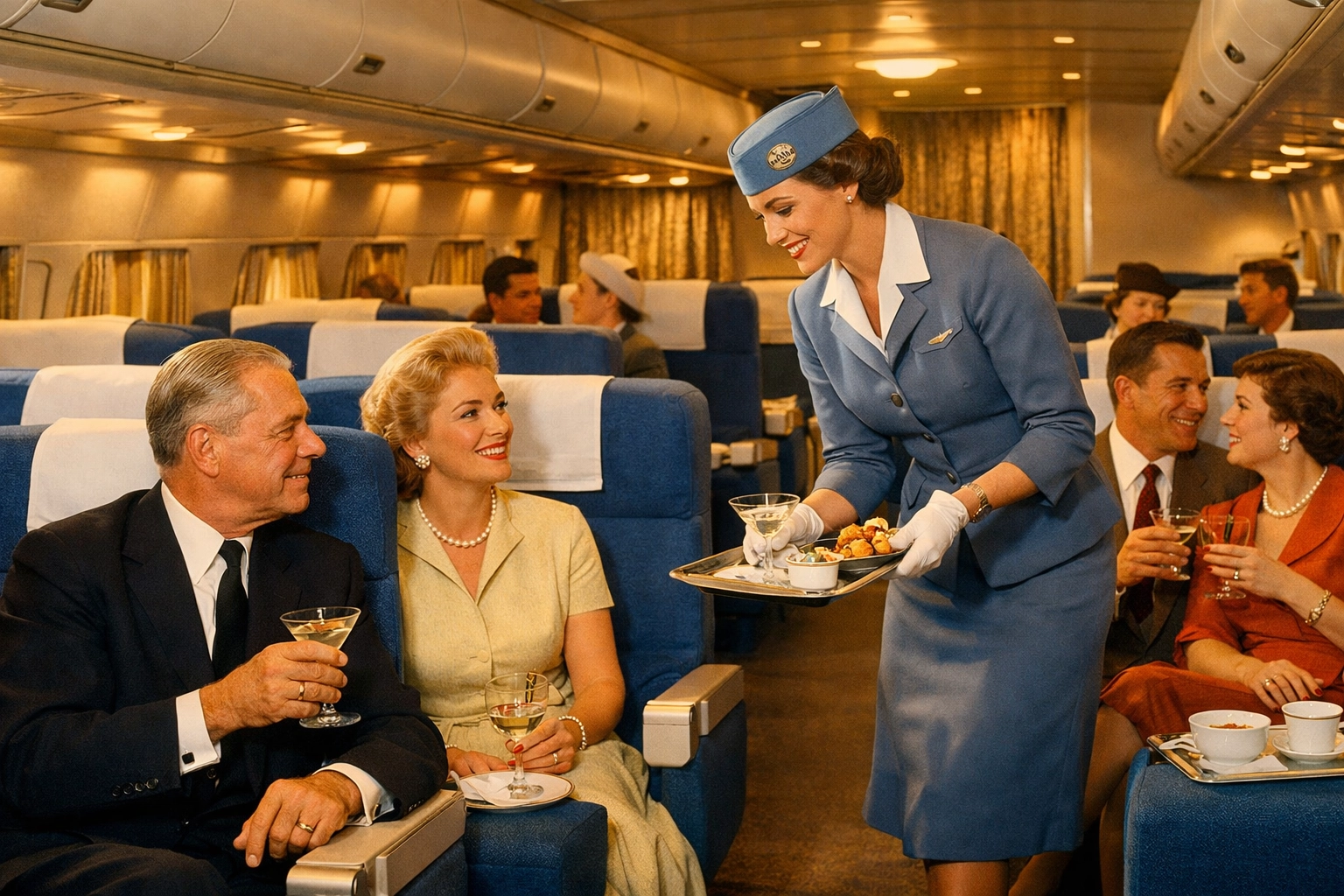
This wasn’t first class. This was the only class available on many flights. Everyone got treated like royalty because airlines competed on service, not just price.
The cost? About $300 for a one-way transatlantic ticket in 1958. That’s roughly $3,100 in today’s dollars. Flying was expensive. Flying was exclusive. Flying was luxury.
The Era of Grand Airlines and Grander Promises
Airlines in the 1950s and 1960s didn’t just sell transportation. They sold experiences. They sold glamour. They sold the dream of international travel to an emerging middle class that had never left their home state, let alone their country.
Pan American World Airways, Pan Am to everyone who remembers it, was the gold standard. Their blue globe logo meant sophistication. Their tagline “The World’s Most Experienced Airline” wasn’t marketing fluff. It was truth.
TWA had Howard Hughes designing aircraft interiors. BOAC (the predecessor to British Airways) offered sleeper seats on long-haul flights. Even domestic carriers like United and American competed on comfort and service.
Your ticket price included everything. Your checked bags. Your meals. Your drinks. Your seat selection. There were no hidden fees because the concept of unbundling services hadn’t been invented yet.
Flying was so special that people who weren’t traveling would dress up and go to the airport just to watch planes take off. Airports had observation decks where families would spend Sunday afternoons. The romance of flight captured imaginations worldwide.
The Technology That Changed Everything
Here’s where things get interesting. The “ruin” of luxury flying wasn’t really a ruin at all, it was democratization. And it started with better planes.
The Douglas DC-3, which entered service in 1936, revolutionized commercial aviation. It could carry 21 passengers, double the capacity of previous aircraft. It was reliable. It was profitable. By 1939, DC-3s carried 90 percent of the world’s airline traffic.
But the real game-changer came in 1970: the Boeing 747.
The 747 changed everything. This massive wide-body aircraft could carry up to 400 passengers in a single flight. Airlines could suddenly transport four times as many people with only marginally higher operating costs.
The economics were simple. More passengers per flight meant lower per-seat costs. Lower per-seat costs meant airlines could charge less and still make money. Lower ticket prices meant more people could afford to fly.
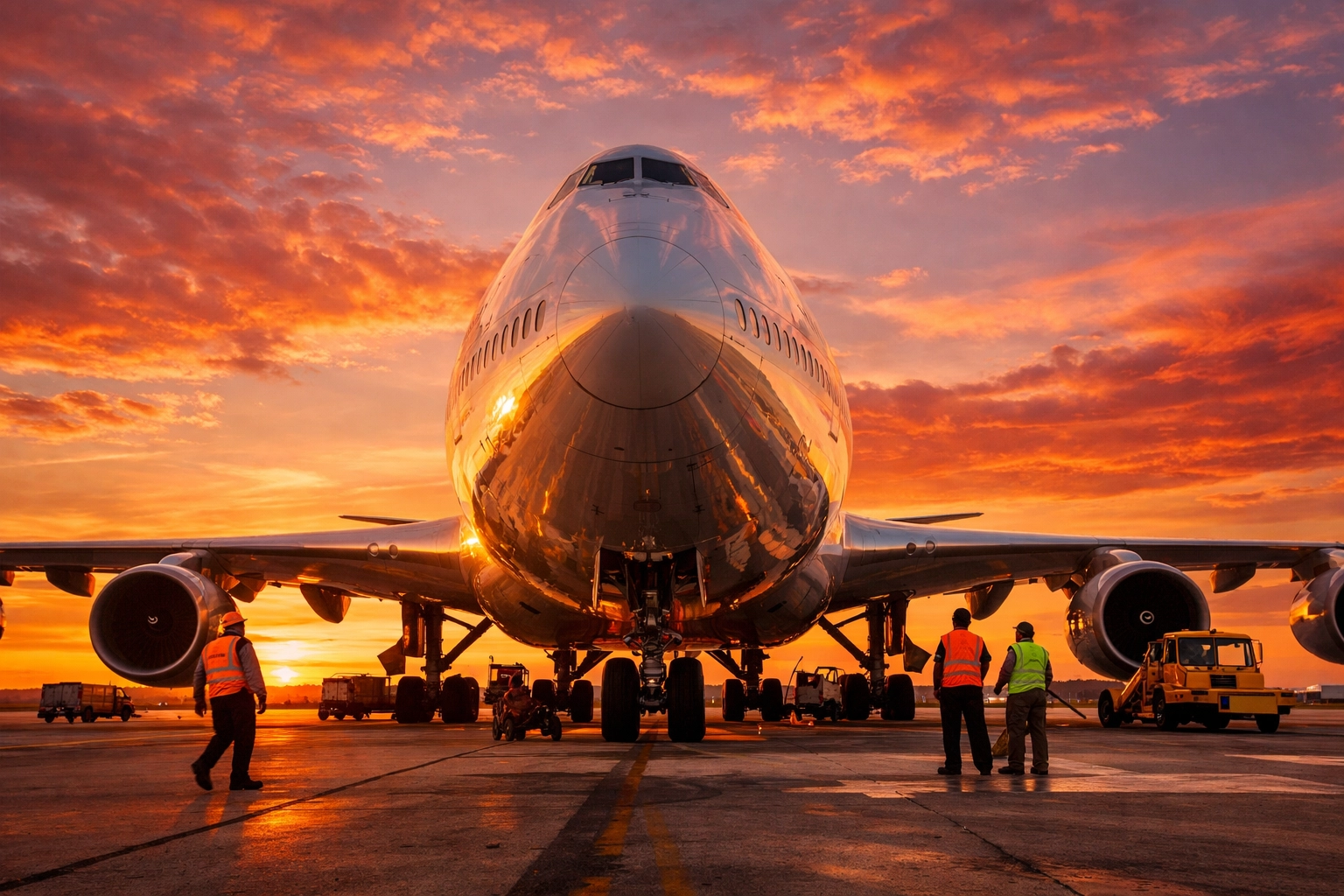
Mass-market aviation was born. Flying went from exclusive to accessible. From special to routine. From luxury to commodity.
The Deregulation Earthquake of 1978
If you want to point to a single moment that transformed American air travel forever, it’s October 24, 1978. That’s when President Jimmy Carter signed the Airline Deregulation Act.
Before 1978, the U.S. government controlled airline routes and ticket prices. Airlines couldn’t just start flying wherever they wanted and charging whatever price the market would bear. The Civil Aeronautics Board approved everything.
This meant airlines competed on service, not price. They couldn’t undercut each other on fares, so they outdid each other with amenities. Better meals. More legroom. Friendlier service.
Deregulation changed the game entirely. Suddenly airlines could fly any domestic route they wanted. They could charge any price they wanted. They could compete however they wanted.
What happened next? Price wars. Aggressive competition. New discount carriers entering the market. And a race to the bottom on service quality.
Airlines realized something crucial: most passengers care more about price than comfort. Given the choice between a $200 ticket with mediocre service and a $400 ticket with excellent service, most people chose the cheaper option.
The market had spoken. The market wanted cheap. The market got cheap.
How Airlines Stripped It All Away
Here’s how airlines systematically dismantled the golden age experience:
First, they shrunk the seats. That generous 18-21 inch width? It became 17-18 inches. Then 16-17 inches on some budget carriers. Seat pitch (the distance from your seat to the one in front of you) went from 34-35 inches down to 30-31 inches. Some ultra-low-cost carriers now offer 28 inches.
Second, they invented fees. Checked bags used to be included. Now they cost $30-75 each way. Seat selection? That’ll be $15-50. Want to board early? Pay up. Need a blanket? That’s $8. Hungry? Snack boxes start at $10.
Airlines discovered they could advertise ultra-low base fares and make up the difference with ancillary revenue. In 2019, U.S. airlines collected over $5.8 billion in baggage fees alone.
Third, they eliminated free food. Those multi-course meals on china? Gone. The free drinks? Gone. Even the free snacks mostly disappeared from domestic flights. You’re lucky if you get a small bag of pretzels now.
Fourth, they packed in more seats. Airlines realized that removing a few inches of legroom throughout the cabin meant they could fit an entire extra row of seats. More seats meant more revenue. Your comfort became secondary to their profit margins.
Fifth, they merged into massive corporations. Competition decreased. Service expectations dropped. When there are only three or four major carriers controlling most routes, passengers have limited options. You either accept the conditions or you don’t fly.
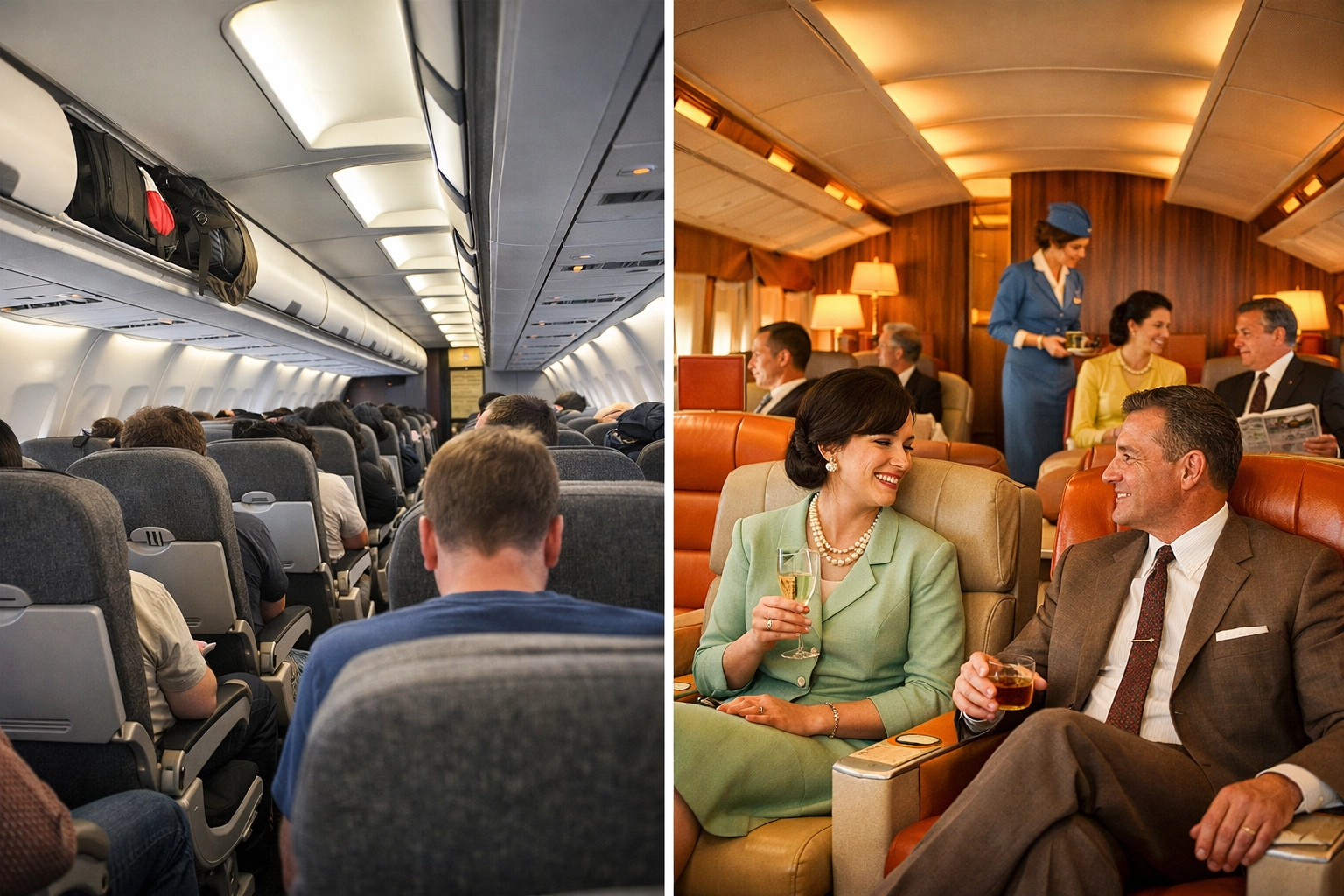
The Modern Economy Experience: A Necessary Evil
Let’s be honest about today’s economy air travel. It’s not luxurious. It’s not comfortable. It’s barely tolerable on long flights.
You arrive at the airport two hours early for domestic flights, three for international. You wait in security lines where you remove your shoes, empty your pockets, and hope you don’t get flagged for random additional screening.
You board the plane through multiple zones designed to extract premium boarding fees from passengers desperate to secure overhead bin space. You squeeze into a seat that seems designed for someone six inches shorter and 30 pounds lighter than you.
The person in front of you immediately reclines into your lap. The person behind you kicks your seat. The middle seat passenger claims both armrests. You’re there for the next four hours.
Want entertainment? Bring your own device and hope the WiFi works. Hungry? Better have downloaded food delivery apps before takeoff or prepared to pay $12 for a sad sandwich.
It’s not flying. It’s mass transit with altitude.
But here’s the thing: you paid $150 for a cross-country flight that would have cost $2,000 in inflation-adjusted 1960s dollars. You get what you pay for.
The Luxury Alternative: Welcome to the Top
Luxury flying didn’t disappear. It evolved. It moved up market. It became more exclusive than ever before.
Modern first-class suites make 1950s luxury look quaint. We’re talking about private cabins with doors. Lie-flat beds with mattress pads. Multiple course meals designed by celebrity chefs. Premium champagne and wine selections. Dedicated flight attendants. Amenity kits worth hundreds of dollars.
Emirates A380 first class has private suites with sliding doors and onboard showers. Yes, showers. At 40,000 feet.
Singapore Airlines Suites Class offers double beds, 32-inch entertainment screens, and service that anticipates your needs before you articulate them.
Etihad’s The Residence is a three-room apartment in the sky with a bedroom, bathroom with shower, and living room. The cost? Around $30,000 for a one-way ticket from New York to Abu Dhabi.
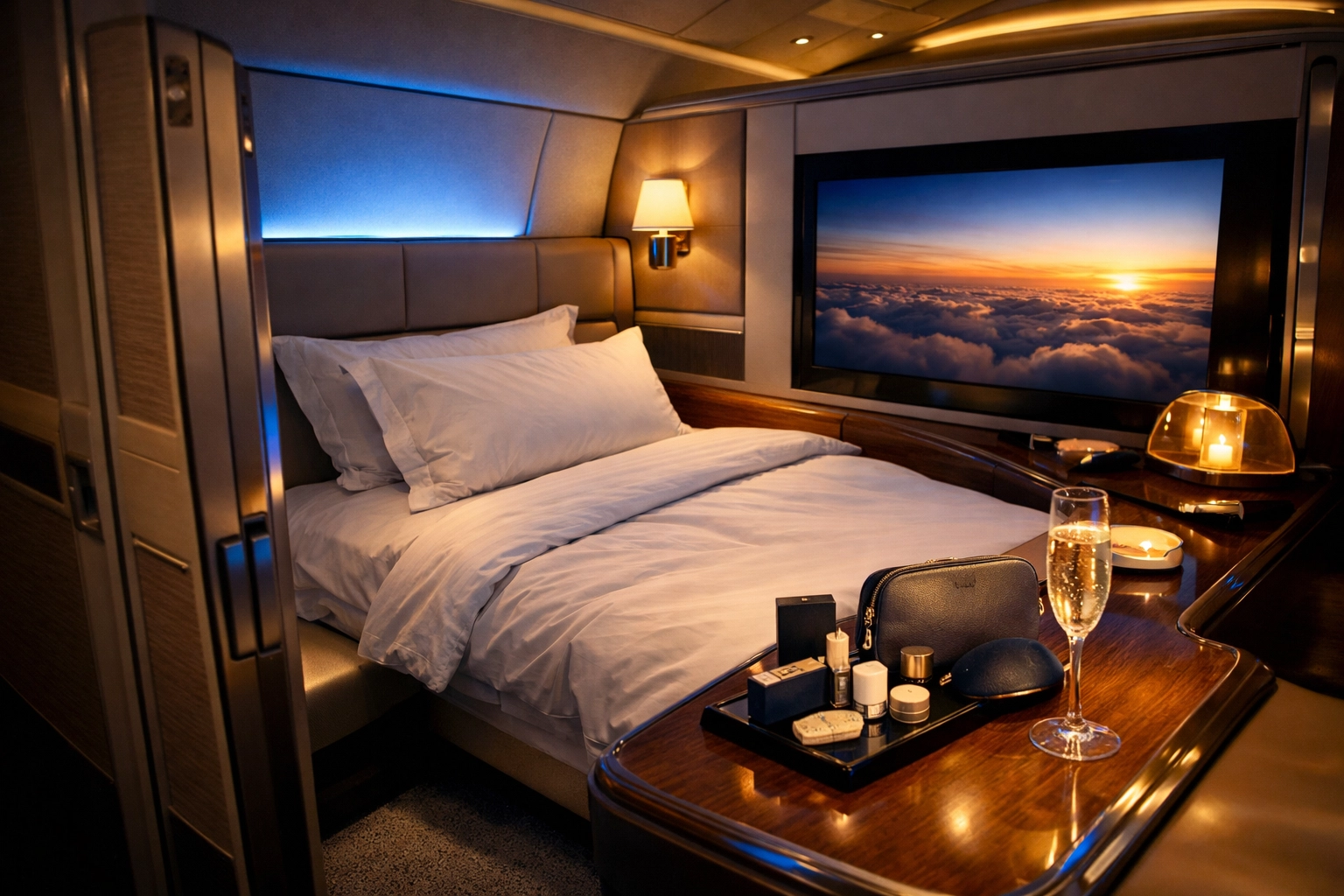
These aren’t seats. These are flying hotel rooms. The golden age passengers would be stunned.
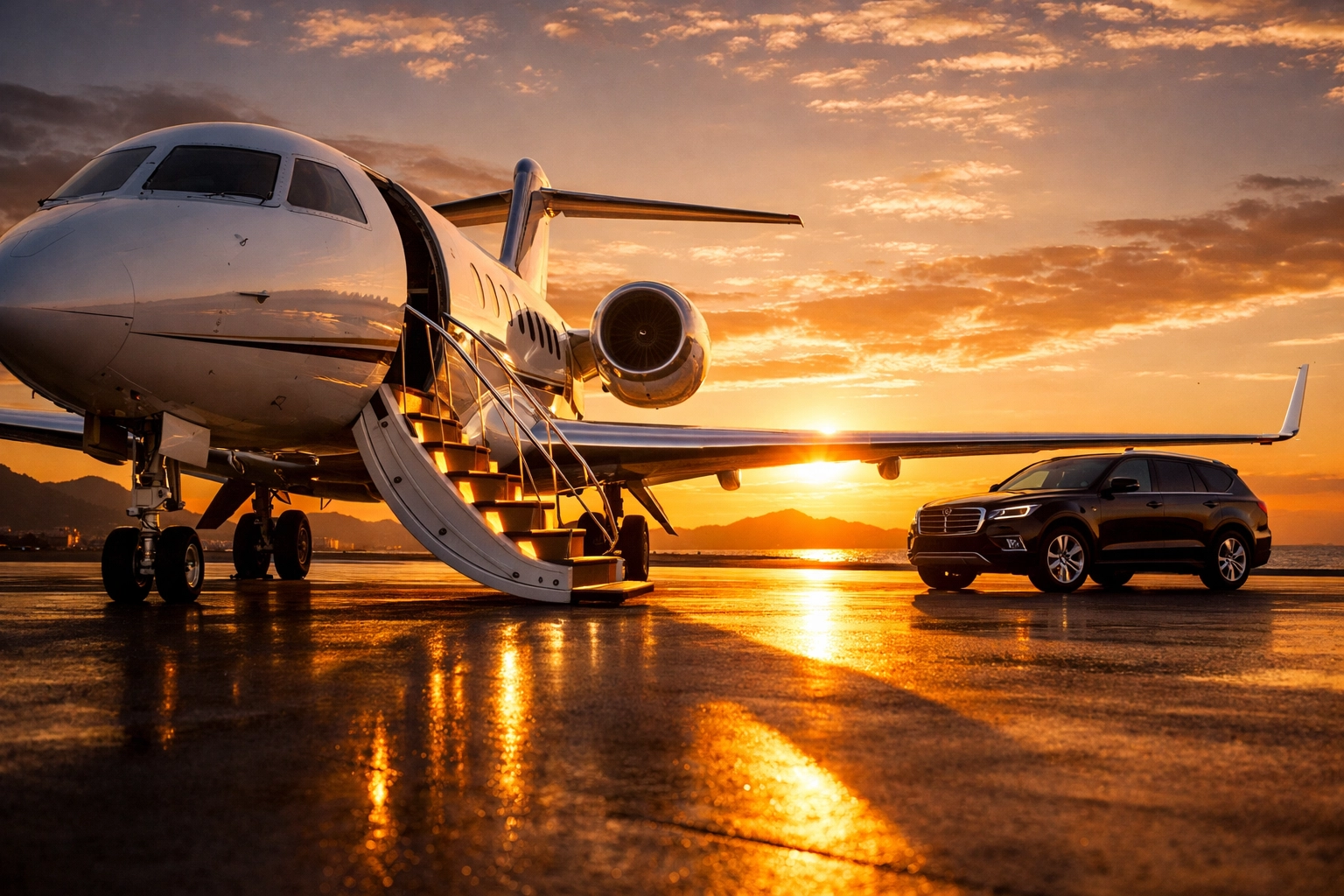
And then there’s private aviation. The truly wealthy don’t fly commercial at all anymore: not even in first class. They charter or own private jets.
NetJets, VistaJet, and Wheels Up offer jet card programs where you pay for flight hours and fly whenever you want. No security lines. No boarding zones. No middle seats. You drive up to the plane, walk up the stairs, and take off.
The cost starts around $5,000 per flight hour. A coast-to-coast flight runs about $25,000-35,000. For that price, you get total privacy, complete schedule control, and the ability to land at smaller airports closer to your destination.
This is how the 0.1% travel now. This is the new golden age: just for far fewer people.
The Business Class Middle Ground
You don’t need to spend $30,000 on a ticket to reclaim some dignity in air travel. Business class on international routes offers a legitimate luxury experience at merely expensive prices instead of absurdly expensive prices.
Most long-haul business class cabins now feature lie-flat seats that convert into actual beds. You get multi-course meals, premium alcohol, priority boarding, lounge access, and significantly more personal space.
A business class ticket from New York to London might cost $3,000-5,000 roundtrip. That’s expensive, but it’s also exactly what flying cost in economy during the golden age (when adjusted for inflation). You’re essentially buying the 1960s flying experience.
Airlines know there’s a market segment willing to pay for comfort but not willing to pay first-class prices. Business class serves that niche perfectly.
The Real Question: Who Actually Ruined It?
So who ruined luxury flying? Let’s assign blame honestly:
The airlines for choosing profit over passenger experience. They didn’t have to shrink seats quite so much. They didn’t have to invent quite so many fees. They chose to because shareholders demanded growth and the easiest path to growth was cutting costs and maximizing revenue per flight.
The government for deregulating without considering long-term service quality implications. Deregulation brought lower prices but it also brought a race to the bottom. There are probably middle-ground regulatory frameworks that could preserve competition while maintaining minimum service standards.
Technology for making mass aviation possible. You can’t put the genie back in the bottle. Once planes could carry 400 passengers efficiently, airlines were always going to fill every seat.
Economics for favoring efficiency over elegance. In a capitalist system, services naturally evolve toward what the market demands. The market demanded cheap flights more than comfortable flights.
Us: the passengers for choosing low prices over good service again and again. Every time we book the $150 flight instead of the $400 flight with better service, we vote with our wallets. We tell airlines that price matters more than comfort. They listen.
The truth is that luxury flying wasn’t ruined by a villain. It was transformed by market forces, technological advancement, and changing consumer priorities. What we lost in universal accessibility we gained in affordability. What we lost in comfort we gained in reach.
Can Golden Age Flying Return?
Some airlines are trying. Singapore Airlines, Emirates, Qatar Airways, and All Nippon Airways consistently rank among the world’s best for passenger service and comfort. They prove that excellent service is still possible: at the right price.
Boutique carriers like JetBlue Mint and La Compagnie offer business-class only flights at competitive prices. They’re betting there’s a market segment tired of economy but priced out of traditional business class.
Even legacy U.S. carriers are slowly improving. New aircraft like the Airbus A350 and Boeing 787 Dreamliner feature better cabin pressure, humidity control, and larger windows. Some airlines are increasing seat width and pitch in premium economy sections.
But a true return to golden age flying for everyone? That’s not economically feasible. Those $3,100 (inflation-adjusted) tickets aren’t coming back for basic economy service. The only way to experience golden-age comfort now is to pay golden-age prices.
Making Your Next Flight Better
You can’t turn back time, but you can make smarter flying choices:
Book premium economy on long flights. You get 2-3 extra inches of legroom and better seat recline for usually 30-50% more than economy. It’s worth it for flights over six hours.
Use airline credit cards strategically. Many premium travel cards offer perks like free checked bags, priority boarding, and lounge access. If you fly regularly, the annual fee pays for itself.
Fly during off-peak times. Business class and first class award availability is much better on Tuesday and Wednesday flights than Friday and Sunday flights.
Consider positioning flights. Sometimes flying from a different nearby airport gets you access to better airlines and cabin classes at similar total costs.
Join loyalty programs and actually stick with them. Elite status with an airline brings complimentary upgrades, free seat selection, and other perks that make economy bearable.
Look at international carriers for long-haul flights. Middle Eastern and Asian carriers often offer significantly better service than U.S. carriers on the same routes.
The Final Verdict
Flying changed. Flying became accessible. Flying lost its glamour.
Was luxury flying ruined? Maybe. Was it democratized? Absolutely. The same changes that eliminated universal comfort also gave millions of people the ability to travel the world who never could have afforded it in the golden age.
You can lament what was lost. You can absolutely complain about cramped seats, hidden fees, and declining service. Those complaints are valid.
But you can also book that transatlantic flight for $300 instead of $3,100. You can visit family across the country for $150. You can take that European vacation you’ve been dreaming about without taking out a second mortgage.
Luxury flying still exists. It’s just expensive again. Very expensive. As expensive as it always was, actually: we just forgot because there was a brief period where everyone flew comfortably at subsidized, regulated prices.
The golden age of aviation wasn’t ruined. It was transformed into something more egalitarian and less elegant. Whether that’s progress or decline depends on your perspective and your bank account.
What’s undeniable is this: flying today is what we collectively chose through millions of individual booking decisions. We chose cheap over comfortable. We chose accessible over exclusive. We chose to visit more places over arriving in style.
We got exactly what we asked for.
Ready to experience luxury travel the way it’s meant to be? Whether you’re looking for guidance on maximizing your flying experience or planning an unforgettable vacation where the journey matters as much as the destination, we’re here to help.
Visit www.TimeForYourVacation.com to start planning your next adventure. Check out www.DaveTheTourGuide.com for personalized travel guidance and insider tips. And keep reading www.TimeForYourVacation.blog for more honest takes on the travel industry and how to navigate it like a pro. And try our Luxury concierge with www.BlackKeyElite.com
 Time For Your Vacation
Leave a comment