![[HERO] How Cruise Ships Manufacture "Fun"](https://cdn.marblism.com/nk1bJiDKE9G.webp)
You didn’t just stumble onto that cruise ship. You were designed to be there.
Every belly flop contest. Every perfectly timed conga line through the Lido deck. Every moment you thought you were spontaneously having fun? That was manufactured. Engineered. Choreographed down to the second by people in conference rooms 18 months before you ever stepped aboard.
Welcome to the multi-billion-dollar machinery of manufactured joy.
I’m not saying you’re not having fun. You absolutely are. But understanding how cruise ships create that fun: the psychology, the architecture, the sensory manipulation, the timing: changes everything. It transforms you from a passive participant into someone who can choose exactly what kind of “fun” you actually want.
And that’s where the real vacation begins.
The Architecture of Joy: How Space Manipulates Your Mood
The moment you step onto a cruise ship, you’re entering a psychological laboratory.
Royal Caribbean’s ships feature those massive promenades: indoor boulevards lined with shops, bars, and restaurants that feel like miniature cities. You think that layout is accidental? It’s intentional crowd flow engineering. The promenade forces you to walk past every revenue-generating venue on the ship. Multiple times. Per day.
Carnival’s “Fun Ship” design philosophy takes a different approach. Their ships feature a vertical layout that pushes you upward toward pool decks and outdoor spaces. The central atrium becomes a theater of constant activity: you can’t escape it. Every time you move between decks, you’re witnessing entertainment, promotions, or activities.
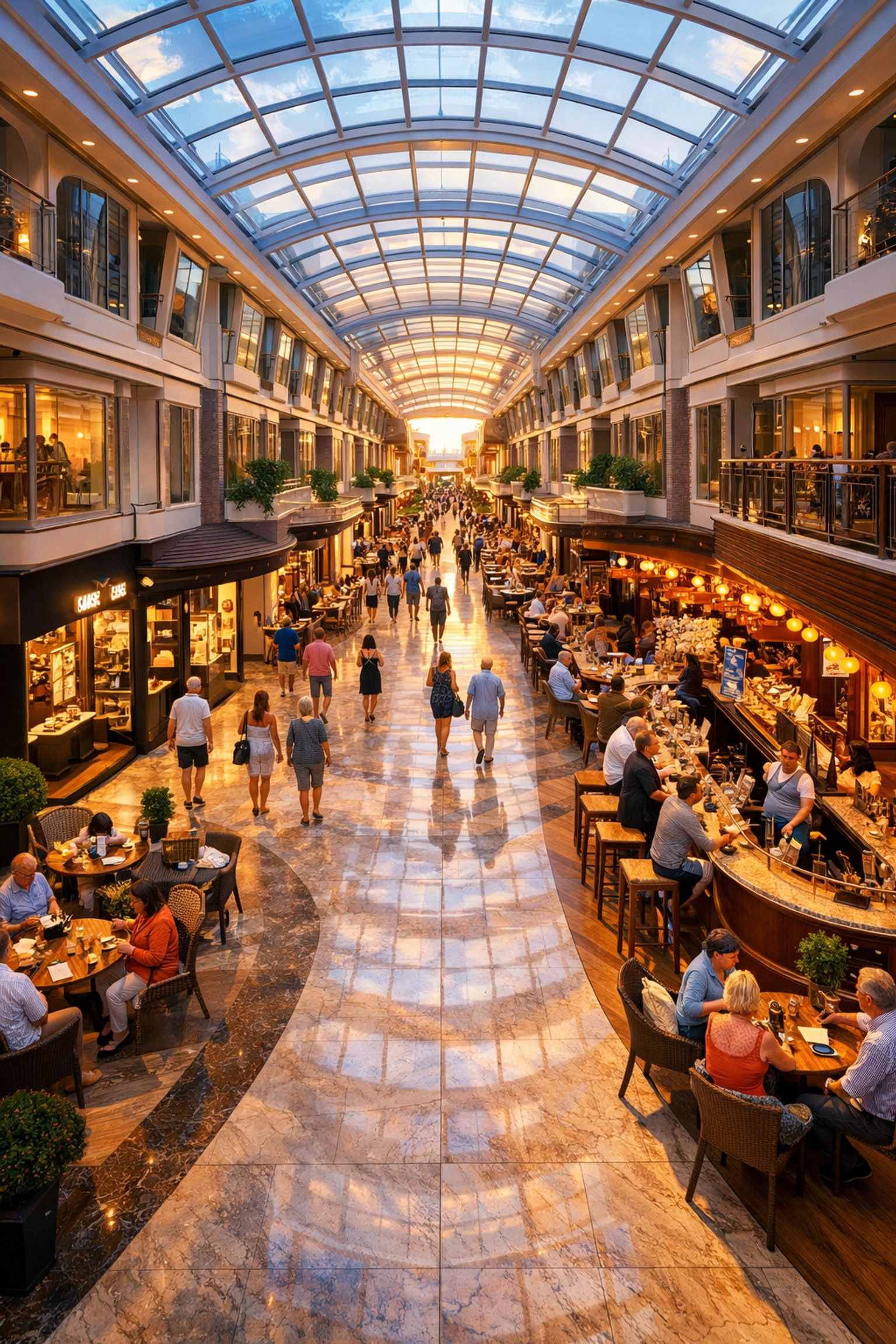
The psychology is brilliant. Wide-open spaces create feelings of freedom and possibility. Narrow corridors with lower ceilings near staterooms create intimacy and relaxation. The casino is always located where you must walk through it to reach dining venues. Not by accident.
Disney Cruise Line masters the themed environment. Their ships use movie-based design to trigger nostalgia and emotional connection before you even participate in an activity. That Art Deco theater isn’t just pretty: it’s priming you to feel like you’re in a golden age of glamorous travel.
Luxury lines like Oceania and Silversea flip this script entirely. Their ships feature asymmetrical layouts with hidden corners, libraries, and quiet observation lounges. The architecture whispers rather than shouts. You discover spaces rather than being funneled through them.
The difference? One approach manufactures constant stimulation. The other curates opportunities for genuine discovery.
The Cruise Director: Orchestrator of Your Every Waking Moment
Let me tell you about the most underestimated person on any ship: the Cruise Director.
This person never sleeps. I’m convinced they’re actually three people rotating in the same uniform.
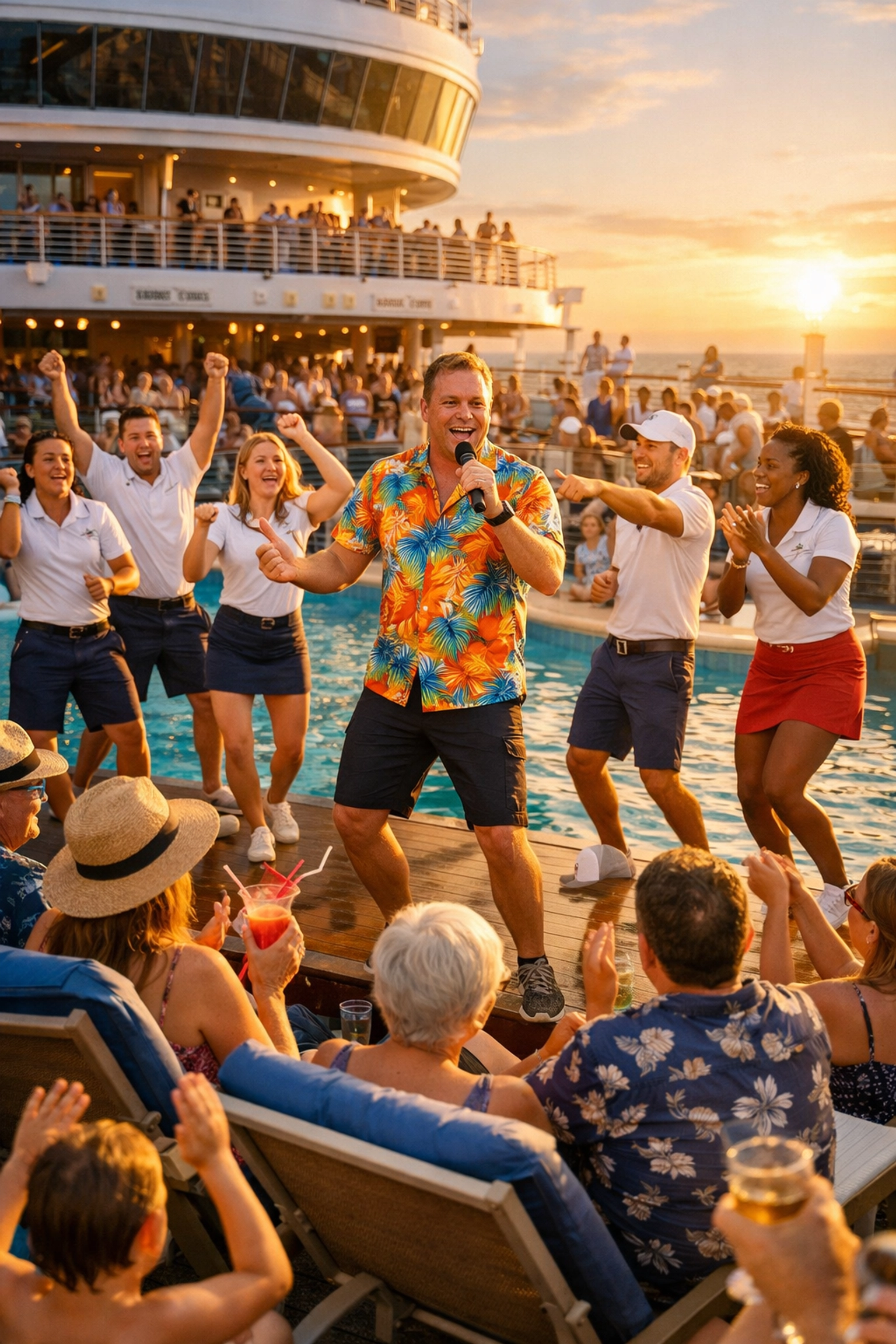
The Cruise Director is part psychologist, part DJ, part camp counselor, and part corporate brand ambassador. They’re reading the crowd’s energy in real-time and adjusting the entire ship’s vibe accordingly. If trivia runs long because people are engaged, the next activity shifts back 10 minutes. If the pool deck feels dead at 2 PM, suddenly there’s an impromptu dance party with a live band.
Everything they do is calculated. That seemingly spontaneous moment when they grabbed the microphone and started a conga line? Planned six months ago during training at Carnival Studios in Davie, Florida: a 44,500-square-foot facility with eight music studios and five full-stage dance studios designed to replicate exact shipboard conditions.
The Cruise Director’s daily schedule isn’t just a list of activities. It’s a behavioral blueprint designed to keep you moving, engaged, and: most importantly: away from your stateroom during peak spending hours.
Morning activities are high-energy to wake you up and get you spending on coffee and breakfast. Afternoon activities are designed around the pool deck bars. Evening activities crescendo toward the main theater shows, with strategic breaks positioned exactly when the casino and specialty restaurants hit peak operating efficiency.
On mega-ships, the Cruise Director manages a team of 30-50 entertainment staff members. On luxury ships, the equivalent role is far more subtle: a concierge approach that suggests rather than orchestrates.
Sensory Engineering: The Science of Vacation Vibes
Close your eyes on a cruise ship. Now tell me what you smell.
Coconut sunscreen. Salt air. That specific blend of chlorine and tropical air freshener near the pool deck. The warm bread smell wafting from the pizzeria.
None of this is accidental.
Cruise lines employ sensory engineers who design the olfactory experience of your vacation. Royal Caribbean pipes custom scent blends through HVAC systems in public spaces. Carnival uses different musical playlists in different zones: Caribbean steel drums near the Lido deck, smooth jazz near specialty restaurants, Top 40 remixes in the main atrium.
The lighting design is even more sophisticated. During embarkation, lights are bright and energetic: welcoming and exciting. As evening approaches, lighting gradually shifts to warmer tones, creating intimacy and romance. Late-night venues feature dynamic lighting that pulses with music, subconsciously keeping you awake and engaged.
Norwegian Cruise Line Holdings operates what’s described as the largest rehearsal complex in the world, featuring 14 full-size-stage studios and 14 vocal studios. Shows are designed with three versions: a fully produced “A version” for normal conditions and modified versions for rough seas. Even the weather is factored into your manufactured fun.
The sound design extends beyond music. Notice how quiet the hallways are near staterooms? Acoustic dampening. Notice how lively the casino sounds? Strategic speaker placement amplifying winning slot machines.
Luxury lines take the opposite approach. Seabourn and Regent Seven Seas engineer silence. Their sensory experience prioritizes the absence of manufactured stimulation: you hear the ocean, real conversation, the clink of crystal glassware.
One approach immerses you in constant sensory stimulation. The other removes distraction so you can notice what actually matters to you.
The Buffet Phenomenon: Food as Performance Art
The cruise ship buffet isn’t about food. It’s about spectacle.
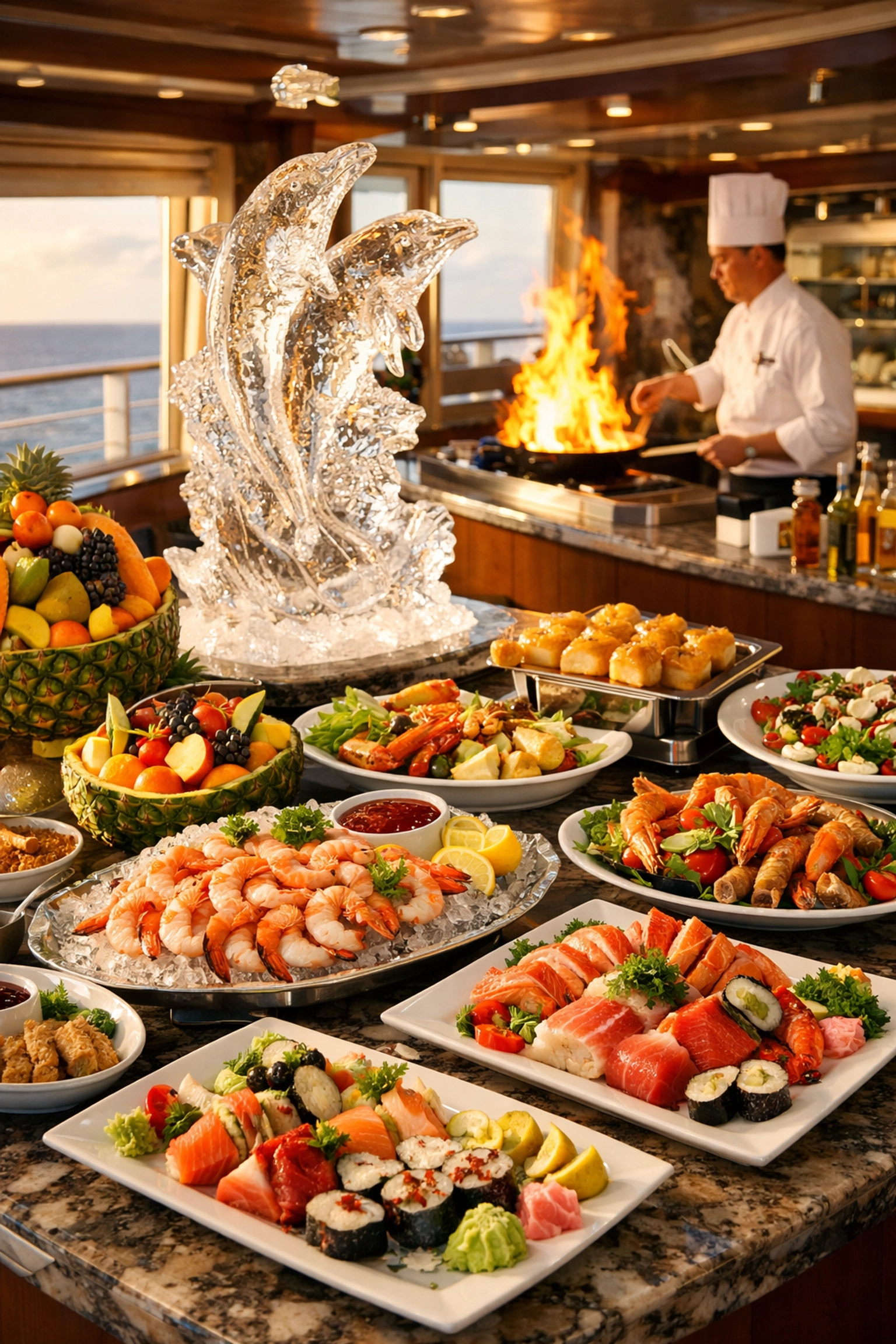
You walk into the Windjammer or Lido Marketplace and you’re confronted with abundance: hundreds of options, ice sculptures, live cooking stations, dessert displays that belong in a museum. The message is clear: you’re getting your money’s worth. Look at all this food. Look at all this value.
The buffet layout is psychologically designed to make you take more food than you want. The plates are smaller than standard restaurant plates: so you make multiple trips and feel like you’re “getting more.” High-margin items like bread and pasta are positioned first. Expensive proteins are positioned in the middle where you’ve already filled your plate.
The live cooking stations aren’t just about fresh food: they’re about the performance. The sizzle. The flames. The chef in the tall white hat. You’re not just eating. You’re experiencing entertainment.
Mass-market lines understand that the buffet serves a secondary purpose: it keeps thousands of passengers fed efficiently while freeing up crew members to prepare for premium dining experiences that generate additional revenue.
Luxury lines approach dining completely differently. Oceania features multiple specialty restaurants included in your fare, with reservations required. Silversea serves meals at your preferred time in intimate dining rooms with tablecloths and sommeliers. The message shifts from abundance to curation.
The difference? One says “look at everything you can have.” The other says “we’ve selected exactly what you should experience.”
“Forced” Fun vs. “Found” Joy: The Belly Flop Contest Paradox
Picture this: It’s 2:30 PM. You’re relaxing by the pool with a book. The cruise director’s voice erupts from speakers you didn’t know existed.
“ALLLLLRIGHT EVERYONE! It’s time for the WORLD FAMOUS BELLY FLOP CONTEST! We need six brave volunteers to compete for the title of BELLY FLOP CHAMPION!”
You have two reactions.
Option one: You put down your book, close your eyes, and wait for it to be over.
Option two: You’re already on your feet, ready to compete.
This is the fundamental divide in cruise ship entertainment philosophy.
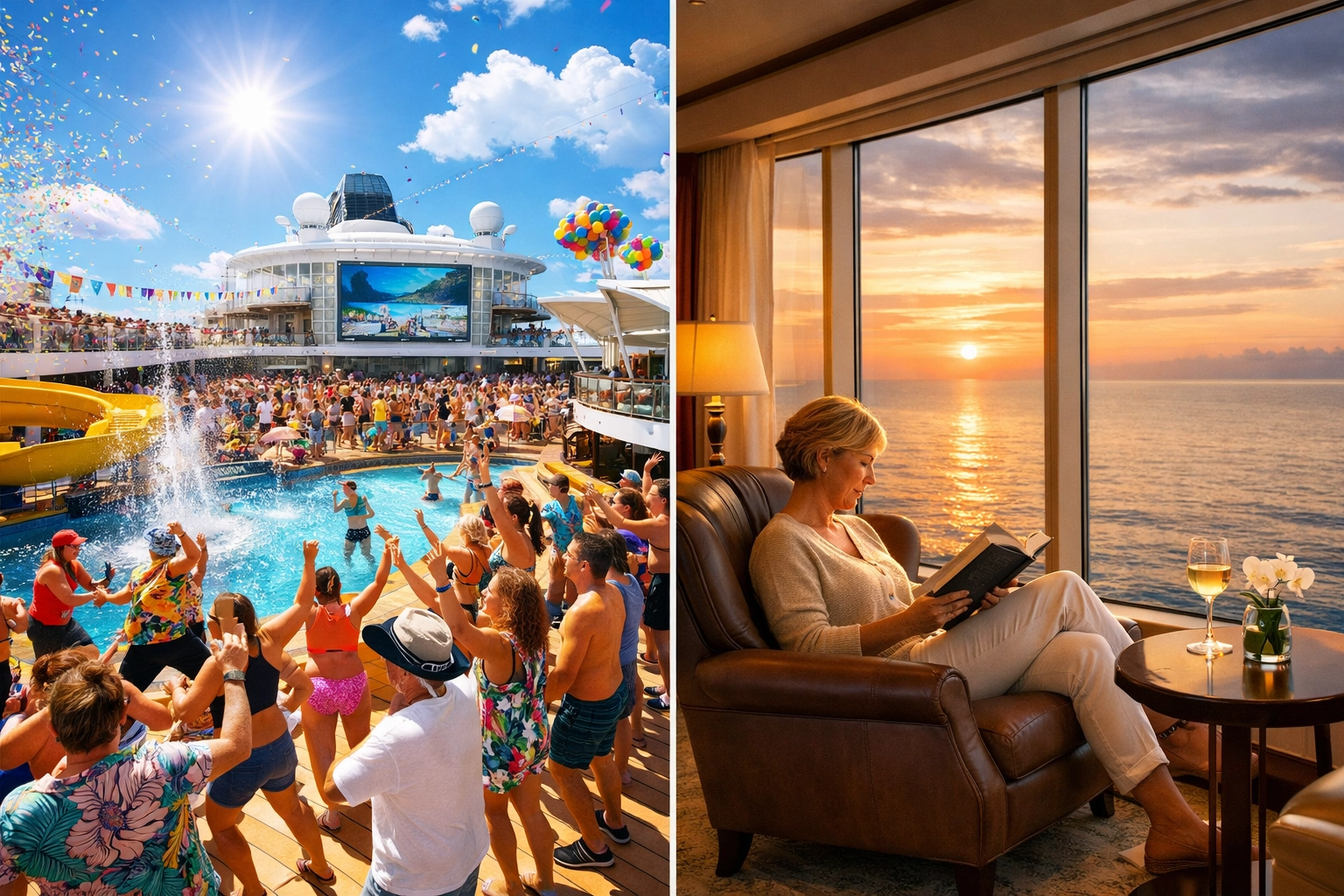
Mega-ships: Carnival, Royal Caribbean, Norwegian: operate on the principle that fun is a contact sport. Participation is achievement. The more activities you do, the better your vacation. Their entire model is built on forced engagement. Hairy chest contests. Newlywed games. Napkin folding demonstrations. Silent disco parties at midnight.
And here’s the thing: millions of people absolutely love this. They want to be told where to go and what to do. They want structure and suggestions and someone else making decisions. They want the energy of a crowd and the validation of participation.
This is manufactured fun at its peak efficiency.
Luxury lines manufacture something entirely different: the space for you to find your own joy.
An evening on Oceania Marina might include a pianist in Martini’s playing Cole Porter standards. You can join the crowd or sit alone with a cocktail. Nobody announces your presence. Nobody hands you a microphone. The entertainment exists as an option, not a mandate.
Silversea’s idea of fun is a marine biologist giving an intimate lecture to 20 guests about tomorrow’s port. Or a cooking class with the executive chef limited to eight participants. The fun is found, not forced.
Neither approach is wrong. But one might be completely wrong for you.
The Schedule Science: Why Everything Happens When It Happens
Pull out your daily newsletter: that printed schedule delivered to your stateroom every evening.
Look at the timing. Really look at it.
7:00 AM – Morning stretches on Deck 10
8:00 AM – Breakfast service begins
9:00 AM – Port talk in the main theater
10:00 AM – Trivia competition
11:00 AM – Mixology class (fee applies)
12:00 PM – Lunch service / Pool deck activities
2:00 PM – Art auction preview
3:00 PM – Bingo
4:00 PM – Sail away celebration
5:30 PM – Evening dining begins
8:00 PM – Main theater production show
10:00 PM – Late night comedy / DJ party
This schedule wasn’t created randomly. It was engineered by teams of behavioral scientists and revenue optimization specialists.
Notice how activities that generate additional revenue: the art auction, mixology class, spa promotions: are strategically positioned during mid-day hours when you’re most relaxed and receptive to spending. Notice how free activities like trivia and bingo create crowd momentum that flows directly into adjacent revenue opportunities.
The evening dining schedule creates two seatings: early and late: that maximize restaurant table turnover. The 8 PM show ensures the casino is empty during the performance, then fills immediately after when guests are energized and looking for more entertainment.
Royal Caribbean’s entertainment director revealed that the typical production timeline is 18 months from concept to opening night. The first three months focus on designs, auditioning costume and scenery shops, and beginning choreography workshops. Nothing is improvised.
Most shows run at least five years aboard ships depending on popularity, then rotate among the fleet. You think you’re seeing a brand new production. It’s been performed 1,500 times.
On luxury lines, the schedule exists more as suggestion than mandate. Regent Seven Seas might list three optional activities for an entire day. The message: your time is yours.
Gamification of Cruising: Apps, Quests, and Digital Manipulation
Modern cruise ships have transformed into floating video games.
Royal Caribbean’s app doesn’t just show your schedule: it assigns missions. Complete three activities and earn a digital badge. Check in at five locations and unlock a special offer. The cruise has become a treasure hunt designed to move you around the ship and expose you to maximum revenue opportunities.
Carnival’s Hub App tracks your activity, suggests experiences based on your behavior, and sends push notifications when activities align with your profile. The AI learns whether you’re a pool deck person or a theater person, then optimizes your schedule accordingly.
MSC Cruises introduced wearable medallions that track your location throughout the ship. This allows crew members to “spontaneously” appear with your favorite drink. It feels like magic. It’s actually just RFID technology and behavioral data.
The gamification serves multiple purposes. It increases engagement. It collects massive amounts of behavioral data. It creates social sharing moments that function as free marketing. And it subtly trains you to view cruise activities as achievements to be unlocked rather than options to be considered.
Luxury lines largely avoid this technology. Silversea doesn’t need an app to gamify your experience: their entire model is built on anticipating needs without digital surveillance. The crew remembers your name and preferences through training and attention, not technology.
How We Filter the Fun: Finding Your Perfect Match
Here’s what many years in luxury travel has taught me: the best vacation isn’t the one with the most activities. It’s the one that matches how you actually want to spend your time.
You don’t need a cruise ship with 47 different activities per day if you want to read a book by the ocean. You don’t need a quiet luxury ship with two optional activities if you want non-stop action and new friends.
At Time For Your Vacation, we act as the filter between you and the manufactured fun machine.
We ask different questions than cruise line marketing departments. Not “what activities are available?” but “how do you actually want to feel on vacation?”
If you want structured activity and high energy and the feeling that you’re maximizing every moment, we’ll match you with Carnival or Royal Caribbean or Norwegian. These ships are engineering marvels of entertainment: and if that’s your personality, you’ll have an incredible time.
If you want space to breathe and discover things at your own pace and feel like you’re being treated as an individual rather than a crowd participant, we’ll guide you toward Oceania, Regent, Silversea, or Seabourn.
If you want something in between: the production values of mega-ships but the sophistication of luxury lines: we’ll introduce you to Celebrity, Holland America, or Princess.
The cruise industry has manufactured every possible version of “fun.” Our job is helping you find the one that doesn’t feel manufactured to you.
The Truth Behind the Curtain
The cruise industry has perfected the science of manufactured joy. Massive rehearsal complexes like Carnival Studios’ 44,500-square-foot facility house 25,000 costumes and eight music studios specifically designed to train performers for ships they’ll never see until embarkation day. Norwegian’s rehearsal complex features 14 full-size-stage studios that exactly replicate theater dimensions, down to the 480-square-foot LED screens.
Hundreds of professionals: performers, musicians, seamstresses, sound technicians, production writers, choreographers, lighting engineers, stage managers: work simultaneously across multiple productions every single day. They’re manufacturing your fun right now, 18 months before you’ll experience it.
Shows require approximately 300 costumes each, specifically engineered to withstand humidity, salt water air, and frequent laundering at sea. Every show has backup versions for rough seas. Every moment is rehearsed six days a week for two months before performers ever step aboard.
This is industrial-scale joy production.
And here’s the beautiful part: now that you know how it works, you can choose whether you want to participate.
You can embrace the manufactured fun fully, understanding that it’s designed to give you an incredible, worry-free experience where every detail is anticipated and handled.
Or you can seek out the cruise lines that manufacture something more subtle: ships that create the conditions for genuine discovery rather than orchestrated participation.
Both are valid. Both are valuable. Both can be exactly what you need.
The question isn’t whether the fun is manufactured. It is. The question is: which flavor of manufactured fun matches who you actually are?
Your Move
The next time you’re standing on a cruise ship pool deck and the Cruise Director announces the belly flop contest, you’ll have a choice.
You can participate enthusiastically, knowing this moment was designed 18 months ago by teams of entertainment professionals specifically to create this exact experience.
Or you can smile, take a sip of your drink, and appreciate the machinery at work while choosing your own adventure.
Either way, you’re finally in control.
Dave Galvan, author of this amazing tome, is a travel author, luxury travel concierge, travel blogger, travel vlogger, travel tour guide, travel podcaster and traveler.
Ready to find your perfect cruise experience? Visit www.TimeForYourVacation.com, www.DaveTheTourGuide.com, and www.TimeForYourVacation.blog to start planning the vacation that actually matches who you are.
 Time For Your Vacation
Leave a comment