![[HERO] Cruise Extras You Should Avoid: How to Keep Your Luxury Vacation from Nickeling and Diming You to Death](https://cdn.marblism.com/kjU_dQhDCsp.webp)
You’ve booked your dream cruise. You’ve paid for the cabin. You’ve locked in the airfare. You’re mentally preparing for umbrella drinks and endless ocean views. Then you board the ship and, surprise!, everything costs extra. The cocktail? Extra. That restaurant you saw in the brochure? Extra. A photo with a guy in a tuxedo? Extra. The art auction promising you’ll triple your investment? Extra (and also a lie).
Welcome to modern cruising, where the sticker price is just the opening bid.
Look, I love cruising. I genuinely do. There’s something magical about waking up in a new port without unpacking your suitcase seventeen times. But let’s be honest: cruise lines have become masters of the upsell. They’ve turned “all-inclusive” into a term so flexible it might as well be made of rubber. And while some extras are genuinely worth it, others are designed to separate you from your money faster than you can say “duty-free.”
So let’s talk about the cruise extras you should absolutely avoid. The ones that sound amazing in theory but deliver disappointment in practice. The ones that prey on your vacation mindset when your guard is down and your credit card is burning a hole in your pocket.
I’m pulling back the curtain on the industry I know inside and out. Consider this your insider’s guide to keeping your luxury vacation from turning into a financial regret.
The Art Auction Trap: Where “Investment” Meets Fantasy
Let’s start with the big one: the art auction.
Picture this. You’re sipping champagne in an elegant gallery space. A charismatic auctioneer is telling you about limited editions and provenance and how this Picasso print will definitely appreciate in value. You’re on vacation. You’re feeling fancy. You’re thinking, “Why not invest in some culture?”
Here’s why not: cruise ship art auctions are not investment opportunities. They’re profit centers. Pure and simple.
The art sold on cruise ships is often mass-produced prints, not originals. That “limited edition” of 500? That’s not limited. That’s mass production with a fancy certificate. And that appraisal showing the piece is “valued” at $5,000? That appraisal came from the same company selling you the art. It’s circular logic designed to make you feel like you’re getting a deal when you “only” pay $2,500.
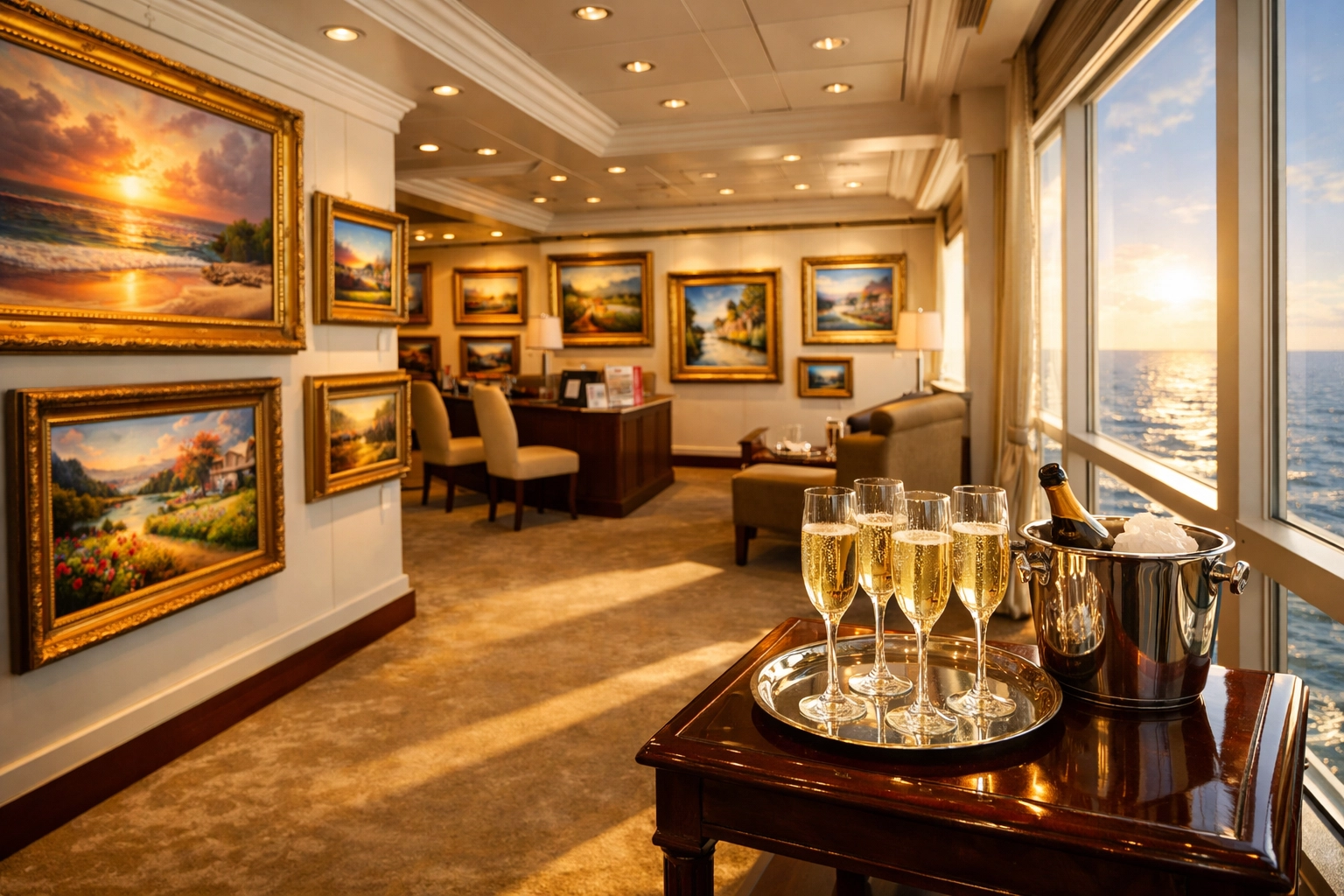
I’ve seen clients come home with cruise ship art they were convinced was an investment, only to discover it’s worth maybe 20% of what they paid when they try to resell it. The secondary market for cruise ship art is dismal because everyone who wants it already bought it, on a cruise ship, after champagne.
The auctioneers are professionals. They’re trained to create urgency, excitement, and FOMO. They’ll tell you that pieces are selling out fast. They’ll point to other passengers bidding. They’ll make you feel like you’re about to miss the opportunity of a lifetime.
You’re not. You’re about to overpay for mass-produced art that will remind you of your vacation every time you look at it. Which, honestly, isn’t the worst thing. But don’t call it an investment. Call it an expensive souvenir.
Hey Look, I buy art on a cruise ship. But I pay less than $50 per piece that I like. I will not pay any more than that.
What to do instead: If you genuinely love a piece and want it as a memento of your trip, fine. Buy it. Enjoy it. Hang it in your home. But skip the auction theatrics and negotiate directly with the gallery during off-hours when the pressure is lower. Or better yet, wait until you’re home and invest in real art from actual galleries where you can verify provenance and value.
Shore Excursion Cattle Calls: The Big Bus Trap
Shore excursions are where cruise lines make a killing. And I mean that literally, they’re killing your budget and your experience simultaneously.
The ship’s standard shore excursions sound convenient. They promise to maximize your limited port time. They guarantee you won’t miss the ship. They provide “expert” guides who will show you the highlights. And let’s understand something, the cruise lines keep the majority of the money you are spending and the excursion is keeping a significantly smaller amount.
What they don’t tell you is that you’ll be herded onto a bus with 50 other passengers, shuttled to the same tourist traps everyone visits, given 10 minutes for photos, and rushed back to the ship. You’ll spend more time in gift shops than experiencing the actual destination. You’ll eat lunch at the restaurant that gives the tour company the biggest kickback. And you’ll pay premium prices for a thoroughly mediocre experience.
I’ve watched passengers pay $149 per person for a “cultural experience” in Cozumel that consisted of a tequila tasting at a tourist trap and a brief stop at a beach club where they were aggressively pitched timeshares. The entire “excursion” could have been done independently for about $30, with better tequila and fewer sales pitches.
The cruise lines defend these prices by saying they guarantee you won’t miss the ship. That’s true. But you know what else guarantees you won’t miss the ship? Booking a private tour with a reputable local guide who knows exactly when you need to be back and treats you like a human being, not a commission opportunity.
What to do instead: Work with a travel professional (hi, that’s us) who can arrange private or small-group excursions that actually immerse you in the destination. We partner with local guides who provide authentic experiences without the cattle-call chaos. You’ll get personalized attention, flexible timing, and real cultural connection. And often, it costs the same or less than the ship’s generic offering.
Or, in many ports, you can simply walk off the ship and explore independently. Most Caribbean and Mediterranean ports are easily walkable from where ships dock. Download Google Maps, do a little research, and create your own adventure. The ship will wait for you as long as you’re back before departure.
Drink Package Math: When “Unlimited” Isn’t Worth It
Drink packages are the great debate of modern cruising. Everyone has an opinion. Some people swear by them. Others feel trapped by them.
Here’s the truth: drink packages make sense for some cruisers and absolutely don’t for others. The problem is that cruise lines have gotten very good at making them seem like deals when they’re often not.
Let’s do the math. A typical unlimited beverage package on a mainstream cruise line runs between $60-$90 per person per day. That’s before the automatic 18-20% gratuity they tack on, which brings your daily cost closer to $70-$108 per person.
To break even at $85 per day, you’d need to drink about 7-8 cocktails or specialty coffees daily (assuming $12-$15 per drink after gratuity). That’s a lot of alcohol. Are you really going to drink 8 mai tais every single day of your cruise? For seven days straight? Your liver is filing a formal complaint just reading this.
For most people, the math doesn’t work. You’d spend less buying drinks as you go, especially if you’re the type who has a couple of cocktails at dinner, a beer by the pool, and maybe a nightcap. Even at cruise ship prices, that’s probably $40-$50 per day, significantly less than the package.

The cruise lines also restrict where you can use packages. Norwegian Cruise Line, for example, doesn’t allow drink packages on their private islands. So you’re paying for “unlimited” drinks but can’t use them at one of the signature experiences of your cruise. That’s not unlimited. That’s limited with an asterisk.
Now, if you’re the type who genuinely drinks from the moment you wake up until you stumble back to your cabin at 2 AM, the package might make sense. If you’re traveling with teenagers who will demolish the specialty coffee and smoothie menu, it could work. But for most people? You’re subsidizing the ship’s bar tab.
What to do instead: Calculate your actual drinking habits. Be honest with yourself. If you have 3-4 drinks per day, you’re probably better off paying as you go. If you’re a heavy drinker (no judgment), the package might save you money.
Better yet, book a cruise line where beverages are already included. Oceania includes unlimited soft drinks, specialty coffees, and bottled water. Silversea includes all beverages including premium liquor. Regent includes everything, including top-shelf spirits and wines. These lines cost more upfront, but when you factor in what you’d spend on drink packages elsewhere, they often come out to the same or less, with far superior quality.
The Spa “Product Pitch”: Relaxation Interrupted
You book a massage. You’re looking forward to 60 minutes of blissful relaxation. The therapist is skilled. The music is soothing. Your muscles are melting.
And then, 45 minutes in, it starts. The pitch.
“Your skin is very dry. You really should try our miracle serum. It’s only $145 for the travel size.”
“I noticed some tension in your shoulders. This magnesium cream would really help. It’s $89, but I can give you two for $150.”
“We have a special promotion today. Buy three products and get a free facial add-on. That’s a $200 value!”
Suddenly, your relaxation has turned into a sales presentation. You’re lying there naked under a sheet while someone who just had their hands on your body is now trying to sell you products. It’s uncomfortable. It’s awkward. And it’s by design.
Cruise ship spas operate on commission. The therapists are evaluated not just on the quality of their massages but on how many products they move. Some are aggressive about it. Others are subtle but persistent. All of them are under pressure to sell, sell, sell.
The products themselves are rarely worth the astronomical prices. You can usually find the same brands online for 30-50% less. Or you can find equivalent products at your local drugstore for even less. That $145 “miracle serum” is probably similar to something you can buy at Target for $25.
What to do instead: Book your spa treatment. Enjoy it. When the product pitch begins, smile politely and say, “Thank you, but I’m all set.” You don’t owe anyone an explanation. If they persist, a firm “No thank you” usually ends it.
If you genuinely love a product they used during your treatment, write down the name and buy it online when you get home. You’ll save money and avoid the awkward sales pressure when you’re trying to achieve zen.
Some luxury cruise lines have spa staff who don’t work on commission, which eliminates the aggressive selling. Regent, Silversea, and Seabourn tend to have more subtle spa experiences. It’s worth asking before you book.
Overpriced Photo Packages: Your iPhone Works Fine
Remember when you needed a professional photographer to capture your vacation memories? Yeah, neither do I. Because we all have professional-quality cameras in our pockets now.
Yet cruise ships still employ roving photographers who snap pictures of you at dinner, by the pool, during embarkation, and at every conceivable moment. Then they display these photos in gallery spaces and charge you $20-$30 per print or $200-$500 for digital packages.
The photos are rarely good. The lighting is harsh. The backgrounds are generic. The poses are awkward because you were caught off-guard while trying to navigate a buffet line. And yet, the cruise lines are betting on your nostalgia and FOMO to make you buy them anyway.
I’ve seen people spend $400 on photo packages they never look at again. The photos get downloaded, filed away on a hard drive, and forgotten. Meanwhile, the candid shots they took with their phones, the ones that actually capture real moments and genuine emotion, those are the ones they share and treasure.
What to do instead: Take your own photos. Your smartphone camera is probably better than the cruise ship’s equipment. Ask fellow passengers or staff to snap pictures of you at key moments. Use the timer feature for couple shots. Take advantage of the incredible scenery you’re cruising through instead of relying on posed shots against a fake backdrop.
If you really want professional photos, wait for formal night. Those portraits can be nice mementos, and you can usually buy just the one or two you really love instead of committing to an entire package. Or negotiate directly with the photographer, they sometimes have flexibility to sell individual images at better rates than the official package prices.
The Casino “Bonus” Illusion: Free Comes with Strings
Cruise ship casinos love to lure you in with “free play” promotions. Sign up for the casino loyalty card and get $50 in free slot play! Attend the casino orientation and receive $25 in complimentary chips! Match play coupons! Prize drawings! Free drinks while you gamble!
Here’s what they don’t advertise: these bonuses are designed to get you through the door, where you’ll likely lose far more than the bonus amount. The “free” slot play can only be used on specific machines with terrible odds. The match play coupons require you to bet your own money first. The prize drawings require you to earn points by gambling, which means you’ve already lost money before you’re even eligible to win.
And those free drinks while gambling? They’re slow to arrive and designed to keep you at the tables longer. You’re not getting free drinks. You’re getting just enough alcohol to lower your inhibitions while you feed money into machines programmed to favor the house.
I’m not anti-casino. If you enjoy gambling as entertainment and set a budget you’re comfortable losing, go for it. But don’t fall for the illusion that casino bonuses are giving you something for nothing. They’re calculated marketing designed to separate you from your money more efficiently.
What to do instead: If you enjoy casino games, set a strict entertainment budget before you start. Treat it like paying for a show, once the money is gone, you’re done. Don’t chase losses. Don’t convince yourself that the next spin will be the winner. And definitely don’t fall for the “bonus” promotions that require you to gamble more to unlock value you’ll probably never see.
If you want to gamble, do it because you enjoy it, not because you think you’re getting a deal. The house always wins. Always.
Wi-Fi Woes: Premium Prices for Mediocre Connections
Cruise ship internet has improved dramatically over the past decade. But it’s still expensive, still often slow, and still absolutely not worth the premium packages most lines push on you.
The cruise lines offer tiered Wi-Fi packages: basic (email only), standard (email and web browsing), and premium (streaming and video calls). The premium packages can cost $25-$40 per day per device. For a week-long cruise, you’re looking at $175-$280 for internet access that’s still slower than what you get free at McDonald’s.
The psychology here is brilliant: they’ve priced the basic package so low ($10-$15 per day) that it feels useless, and the premium package so high that it feels like luxury. So most people end up in the middle with the standard package, which is exactly where the cruise line wants you, paying for internet that works just well enough to keep you from complaining but not well enough to actually enjoy.
Here’s the truth: unless you absolutely need to work during your cruise or have a family emergency situation, you don’t need internet. You definitely don’t need streaming capability. You’re on vacation. The whole point is to disconnect.
I admit, I always get a wifi package so I can communicate with my kids while on the my trip, and be able to upload pics and videos to social media while out and about. But, for me, it’s a tax write-off.
What to do instead: Embrace the digital detox. Let people know you’ll have limited connectivity before you leave. Check email once a day in port using free Wi-Fi at a café. Use your cruise as an opportunity to actually be present instead of scrolling through Instagram comparing your vacation to everyone else’s.
If you truly need to work or stay connected, buy the minimum package that accomplishes your goals. Don’t pay for streaming when you could be watching the ocean. And definitely check the port schedule, many ships now offer free or very cheap Wi-Fi when docked in port, which might be all you need.
The luxury lines are starting to include Wi-Fi in their base fares. Regent, Silversea, and Crystal all include unlimited internet. If connectivity is crucial for you, factor that into your cruise line selection rather than paying for overpriced packages afterward.
Fitness & Wellness Upsells: The Free Gym Works Fine
Cruise ship gyms are remarkably well-equipped. They have cardio machines with ocean views. They have weights, yoga mats, and usually some group fitness classes included in your cruise fare.
But then you see the signs for the “premium” wellness experiences. The personal training sessions at $100 per hour. The boot camp classes for $25 per session. The Pilates reformer classes for $35. The “wellness consultations” that are really just sales pitches for supplements and programs.
These aren’t worthless, some people genuinely value structured fitness instruction on vacation. But ask yourself: are you really going to maintain a workout routine on a cruise? Are you the type who hits the gym at home consistently? Because if you’re not working out at home, you’re probably not going to start during your vacation regardless of how much you spend.
The free group fitness classes are usually perfectly adequate. The gym equipment is available anytime. You can run on the track. You can swim in the pool. You can do yoga on your balcony. None of these require extra fees.
What to do instead: Use the included fitness facilities. Try the free group classes. If you really want instruction, watch a YouTube workout video in your cabin. Or embrace the fact that you’re on vacation and maybe it’s okay to take a week off from your fitness regimen.
If wellness is genuinely important to you, book a cruise that specializes in it from the start. Some lines, like Oceania’s wellness cruises or Seabourn’s Spa & Wellness voyages, include extensive programming in the base fare. You’ll get better instruction and more comprehensive experiences than paying a la carte for upcharges on a regular cruise.
Specialty Dining Reality Check: Is It Actually Special?
This is where things get complicated, because specialty dining can legitimately be worth it, on some ships, for some restaurants, for some diners.
The cruise lines have shifted their strategy over the past decade. They used to include all dining in your cruise fare. Now, the main dining rooms serve perfectly acceptable food, but the really exciting venues charge extra. Want the steakhouse? $50 per person. Italian restaurant? $35 per person. Sushi? $45 per person. It adds up fast.
What’s frustrating is that many of these specialty restaurants aren’t actually that special. They’re using the same kitchen, often the same ingredients, just with fancier plating and a different tablecloth. The $50 steakhouse steak isn’t dramatically better than the main dining room steak. The $35 Italian pasta isn’t significantly superior to what you could order in the regular restaurant.
Some specialty restaurants are worth it. The small, intimate venues with actual specialty chefs and unique menus can be genuinely excellent. But the large specialty restaurants that seat 200 people? Those are just the main dining room with a cover charge.
The other issue is that some cruise lines have shifted from flat fees to per-item pricing. What used to be a $25 cover charge is now $12 for this appetizer, $35 for that entrée, $8 for dessert. You can easily spend $70-$80 per person without realizing it, which is absurd on a cruise where you’ve already paid for food.
With that said, I do occasionally take my wife out to a special dinner when there is a special occasion. Birthdays, anniversary, Valentines Day of 2025 I was in a steak house aboard Royal Caribbean’s Liberty of the Seas with my wife enjoying a very good steak.
What to do instead: Research the specialty restaurants before you book. Read reviews from actual passengers, not the cruise line’s marketing materials. Look for the small, genuinely unique venues with specialized cuisines.
Better yet, choose a cruise line where specialty dining is included. Oceania includes all specialty restaurants in your fare. Regent, Crystal, and Silversea include everything. You can try every restaurant without worrying about the bill.
If you’re on a ship with upcharges, try one specialty restaurant if you’re curious, but don’t feel obligated to dine at every venue. The main dining room food is usually very good. Room service is typically free (though some lines now charge for that too). You won’t go hungry, and you won’t miss out on essential experiences by skipping the specialty venues.
The exception: if there’s a celebrity chef restaurant you’re genuinely excited about, go for it. Thomas Keller’s restaurant on Seabourn, for example, or the Ritz-Carlton Yacht Collection’s Evrima restaurants. Those are curated experiences worth paying for. But the generic “Italian restaurant” or “steakhouse” on most ships? Skip it.
The Benefit of Working with an Expert: How to Avoid the Trap Altogether
Here’s the thing about all these cruise extras: they exist because the base fare has been compressed to make cruising seem affordable. The cruise line advertises a seven-night Caribbean cruise for $699 per person, and that sounds amazing. Then you board and discover that pretty much everything costs extra.
You end up spending $1,500 per person on top of the base fare for drinks, dining, excursions, photos, Wi-Fi, gratuities, and miscellaneous upcharges. Your $699 cruise actually cost $2,199. Which might still be a good value, or it might not, depending on what you got for your money.
The smarter approach is to work with a travel professional who understands the true cost of cruising and can match you with the right cruise line for your expectations and budget.
If you want all-inclusive without thinking about costs, we’ll put you on Regent or Silversea where literally everything is included, drinks, dining, excursions, gratuities, Wi-Fi, everything. Yes, the base fare is higher. But the final cost is often comparable to a mainstream cruise once you add up all the extras, and the experience is dramatically superior.
If you want a great value with sensible inclusions, we might suggest Oceania, where specialty dining, soft drinks, and bottled water are included, but alcohol is extra. Or Celebrity, which has found a good middle ground with some inclusions and reasonable upcharges for premium experiences.
If you’re on a tight budget and genuinely don’t mind paying as you go, we can explain exactly what’s included on mainstream lines like Royal Caribbean, Carnival, or Norwegian, so you can budget accordingly and won’t be shocked by charges.
The key is knowing before you book. Understanding what’s included, what costs extra, and what those extras actually deliver. That way you’re making informed decisions, not impulse purchases when you’re on the ship with your guard down.
We also arrange private shore excursions that blow away the ship’s cattle-call tours: often for the same price or less. We connect you with local guides who provide authentic experiences, not tourist traps. We build in buffer time so you’re never stressed about missing the ship. And we tailor everything to your interests instead of herding you with 50 strangers.
The Bottom Line: Cruise Smart, Not Hard
Look, cruising is supposed to be fun. It’s supposed to be relaxing. It’s supposed to be the vacation where you don’t think about logistics or planning because everything is handled.
But it’s also big business. Cruise lines are public companies with shareholders expecting growth. They’ve figured out that they can advertise low base fares to get people through the door, then make their real profits on upsells once you’re trapped: I mean, once you’re on board enjoying your vacation.
You don’t have to fall for it. You can be smart about what you spend on and what you skip. You can research before you book. You can choose cruise lines whose inclusions match your expectations. You can work with professionals who help you avoid the traps.
You can have an incredible cruise without feeling nickel-and-dimed to death. It just requires being thoughtful about what actually enhances your experience and what’s just separating you from your money.
Skip the art auction. Arrange private excursions. Do the drink package math. Politely decline the spa products. Take your own photos. Avoid the casino bonuses. Disconnect from Wi-Fi. Use the free gym. Be selective about specialty dining.
And most importantly, work with someone who knows the industry inside and out. Someone who’s actually been on these ships, experienced these extras, and knows which ones deliver value and which ones are pure profit padding.
That’s where Time For Your Vacation comes in. We’re not just booking agents. We’re your advocates. We’re the friend who’s been there, done that, and learned the lessons so you don’t have to. We match you with the right cruise line, negotiate the best pricing, arrange superior shore experiences, and give you honest advice about what’s worth your money and what’s not.
Because your vacation should be about the experience, not the bill. About the memories, not the regrets. About enjoying the journey, not calculating whether you drank enough mai tais to justify that beverage package.
You deserve better than being treated like a walking ATM. You deserve a cruise that delivers on its promises without constantly reaching for your wallet.
Let’s make that happen.
Dave Galvan, author of this amazing tome, is a travel author, luxury travel concierge, travel blogger, travel vlogger, travel tour guide, travel podcaster and traveler.
Ready to plan a cruise that won’t nickel and dime you? Let’s talk. Visit www.TimeForYourVacation.com, www.DaveTheTourGuide.com, or www.TimeForYourVacation.blog to connect. You can also catch my podcast at https://www.podomatic.com/podcasts/contact24682 where we dive even deeper into luxury travel secrets the industry doesn’t want you to know.
 Time For Your Vacation
Leave a comment