![[HERO] The Worst Travel Advice I've Ever Heard (And What to Do Instead)](https://cdn.marblism.com/PiDa7XByhT2.webp)
Look, I’m going to be real with you.
The internet is full of travel advice. And I mean full of it. Pinterest boards promising “life-changing hacks.” Reddit threads swearing by oddly specific booking times. TikTok influencers shouting about how you absolutely must do everything their way or you’re doing it wrong.
Here’s the problem: most of that advice ranges from mildly annoying to trip-ruiningly terrible.
After years of planning luxury travel experiences, and fixing the disasters that happen when people follow bad advice, I’ve compiled the worst offenders. These are the travel “tips” that sound smart but actually cost you time, money, stress, and the kind of vacation memories you actually want to make.
Let me save you some headaches.
“Just Wing It!” (Or: How to Turn Paradise Into a Planning Nightmare)
This one drives me absolutely insane.
“Just wing it!” they say. “The best travel is spontaneous!” they insist. “You’ll find better deals when you get there!”
No. No. And hell no.
Here’s what actually happens when you wing it in the world of luxury travel: you end up in the worst room at the hotel. You miss out on the excursions everyone raves about because they’ve been sold out for weeks. You spend your “relaxing” beach day frantically googling “best restaurants near me” while everyone around you is sipping cocktails they pre-ordered.
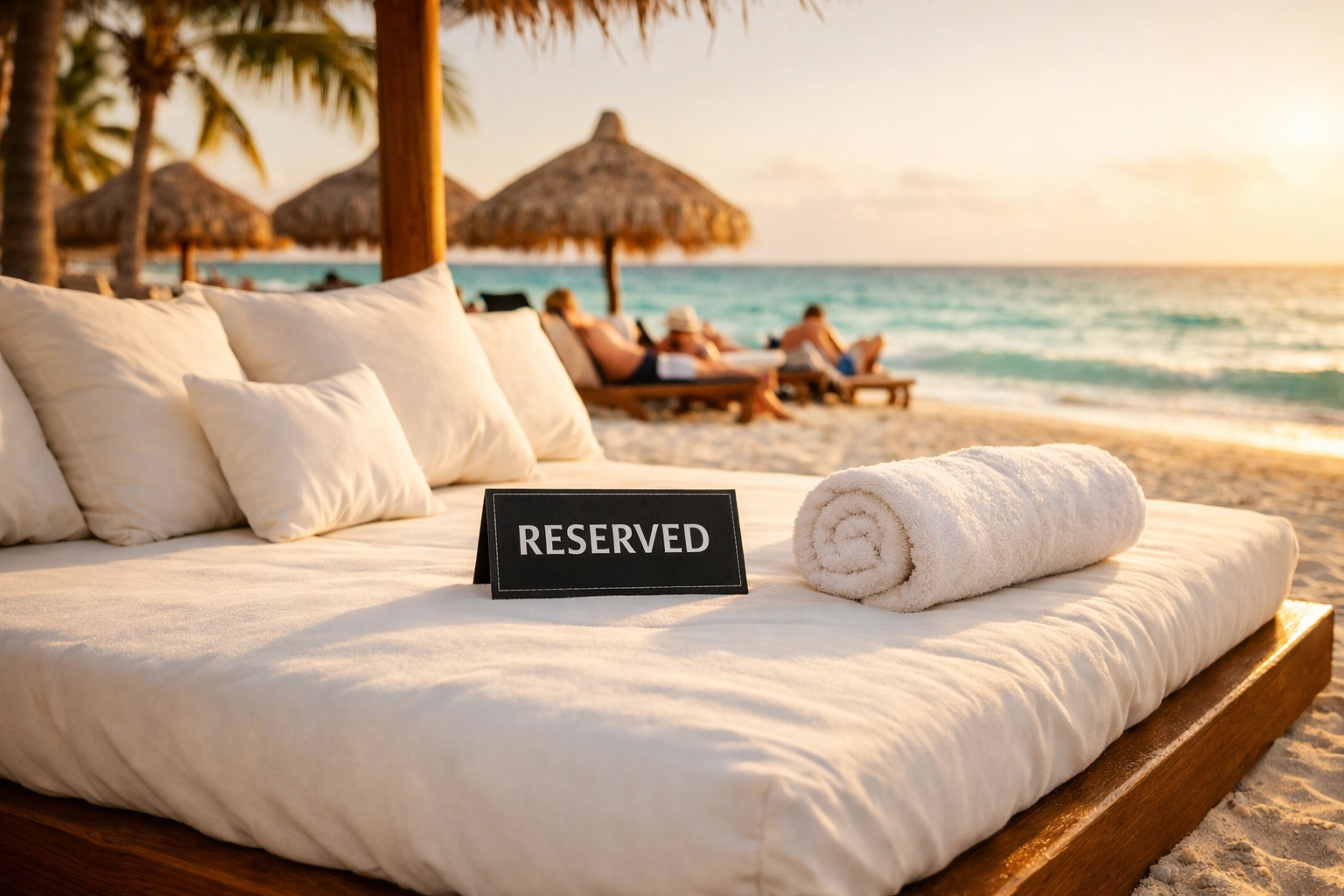
Let me give you a real example. Paradise Beach in Cozumel, Mexico. It’s one of those dreamy beach club destinations where cruise passengers spend their port day. Beautiful turquoise water. Comfortable beach chairs. Snorkeling. Cold drinks. The works.
But here’s the catch: if you show up without planning, you’re either not getting in or you’re paying premium prices at the door while everyone who booked ahead is already three piña coladas deep on their reserved daybed.
The “wing it” crowd? They’re the ones standing in the taxi line at the port, squinting at their phones, trying to figure out where to go while their precious port time ticks away.
Spontaneity has its place. Deciding between the grilled fish and the shrimp tacos? Wing it. Choosing to stay an extra hour at the beach? Absolutely, wing it. But your accommodations, your transfers, your major activities? That’s not spontaneity. That’s gambling with your vacation.
What to do instead: Plan the framework. Book the big stuff. Reserve the experiences you know you want. Then be spontaneous within that structure. You’ll have the freedom to explore knowing you’ve got a great room to return to and dinner reservations at the spot you’ve been dreaming about.
“Book Your Flights on a Tuesday at 3 AM” (And Other Booking Myths That Need to Die)
Oh, this one. This persistent, zombie-like myth that just won’t die.
“Book on Tuesday!” “Clear your cookies!” “Search in incognito mode!” “Buy exactly 47 days before departure!” “Only book during a waning crescent moon while Mercury is in retrograde!”
Okay, I made that last one up. But you get the point.
Here’s the truth that the “hack” peddlers don’t want you to know: there is no magic time to book flights. Airlines use complex revenue management systems that adjust prices based on hundreds of variables. Demand, competition, seasonality, booking pace, how many people searched that route in the last hour, it’s algorithmic chaos.
That Tuesday at 3 AM “hack”? It came from a study. One study. From 2013. About domestic U.S. flights. And it wasn’t even that significant a difference.
Meanwhile, you’re setting alarms, refreshing browsers, and treating flight booking like some kind of covert military operation. And for what? Maybe you save $23. Maybe you don’t. Maybe you lose sleep and miss the actual good deal that showed up on Thursday afternoon.
You know what makes a bigger difference than clicking “buy” at precisely 3 AM? Actually knowing how to book travel. Understanding fare classes. Knowing which routes have better pricing. Recognizing when a price is genuinely good versus waiting-for-a-miracle unrealistic. Being aware of packages like JetBlue Vacations that bundle flights and hotels at rates you literally cannot replicate by booking separately.
What to do instead: Work with someone who books travel for a living. Someone who isn’t setting alarms for 3 AM because they have tools, knowledge, and industry relationships. Someone who can tell you, “That’s a solid price, let’s book it” or “Let’s wait, I’ve seen this route drop by next week.” Your time is worth more than gambling on flight hack mythology.
“Avoid Tourist Traps at All Costs” (Or: Why Popularity Isn’t a Crime)
Let me ask you something.
Why do you think places become popular?
Usually, it’s because they’re actually good.
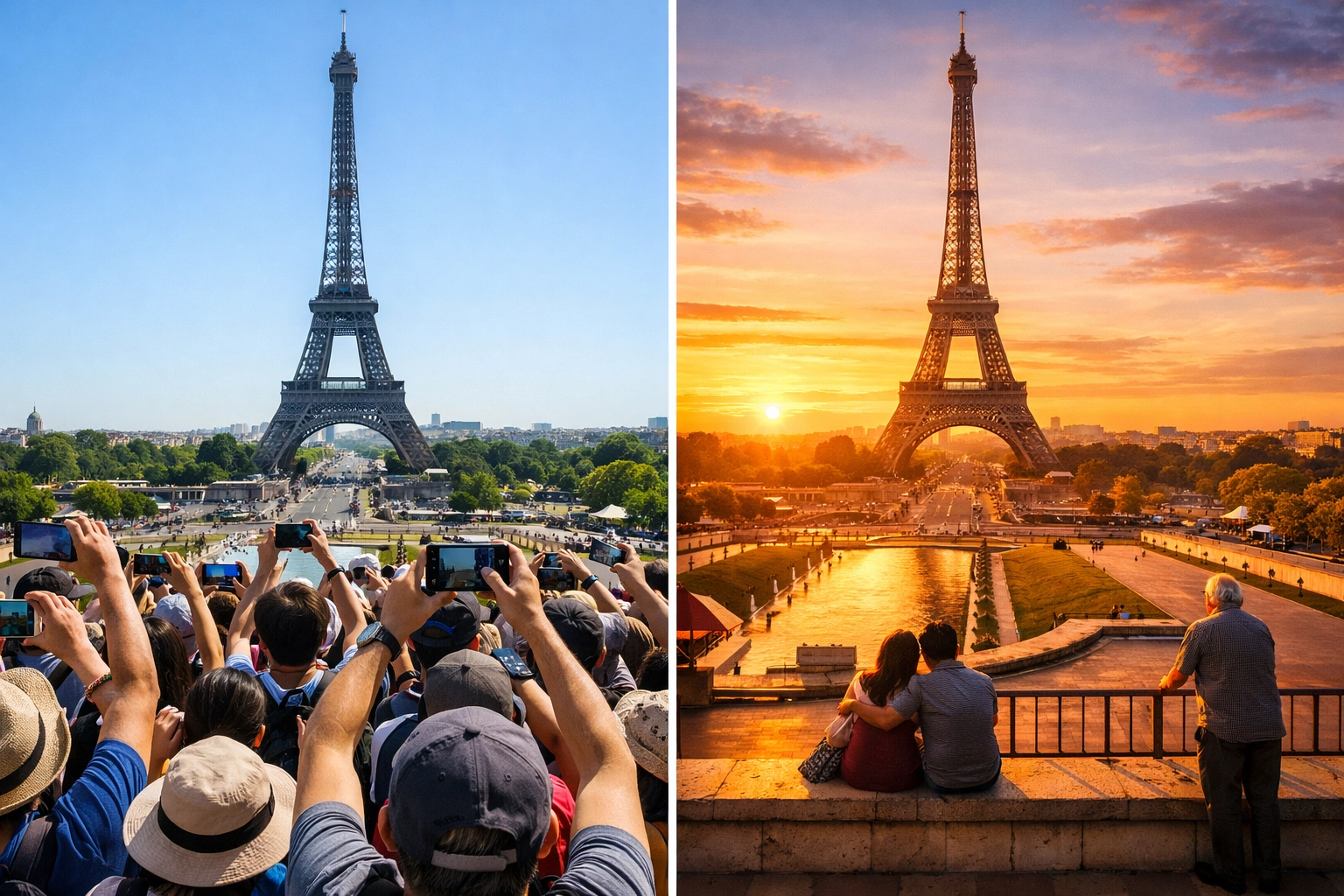
Yes, some places are overhyped. Yes, some destinations are crowded for reasons that have nothing to do with quality. But the blanket advice to “avoid tourist traps” has created this weird travel snobbery where people brag about how they avoided the Eiffel Tower or skipped the Grand Canyon because they’re “too touristy.”
You flew to Paris and didn’t see the Eiffel Tower because you wanted to feel superior to other travelers? Congratulations, you played yourself.
Here’s the real secret: the trick isn’t avoiding popular places, it’s visiting them the right way.
Cozumel is packed with cruise passengers. Does that make it a “trap” you should skip? Absolutely not. You just need to know how to do Cozumel. Book your excursions in advance. Know which beach clubs are worth it. Understand that taxis only take cash (and charge $18 cash versus $40 with a credit card, yeah, we’ll get to that scam in a minute). Go to the places that cruise passengers rave about, but do it with a plan.
Vegas? Ultra-touristy. Also? An absolute blast if you know which shows to see, which restaurants to book, and which “deals” are actually bad deals wrapped in neon.
The Instagram-famous spots? Some are genuinely stunning. Others are disappointments. But you won’t know which is which by categorically avoiding anything popular. You’ll know by doing actual research or, even better, working with someone who’s already sorted the gems from the garbage.
What to do instead: Judge each destination on its actual merits, not its tourist-to-local ratio. And if something is crowded, figure out when to go, how to experience it, and what to skip. That’s the kind of insider knowledge that makes trips memorable, not travel snobbery.

“You Don’t Need a Travel Agent” (The Biggest Lie of the Digital Age)
This is the one that really gets under my skin.
“You don’t need a travel agent! You have the internet! You can book everything yourself!”
Sure. You can book everything yourself. You can also cut your own hair, fix your own plumbing, and represent yourself in court. The question isn’t “can you”, it’s “should you?”
Let’s talk time. Real talk.
How long did you spend researching your last vacation? Comparing hotels? Reading reviews? Cross-checking dates? Finding restaurants? Mapping out logistics? Debating whether Resort A is actually better than Resort B even though Resort B has a lazy river but Resort A has that adults-only pool?
If you’re honest, it was probably 20-40 hours. Maybe more.
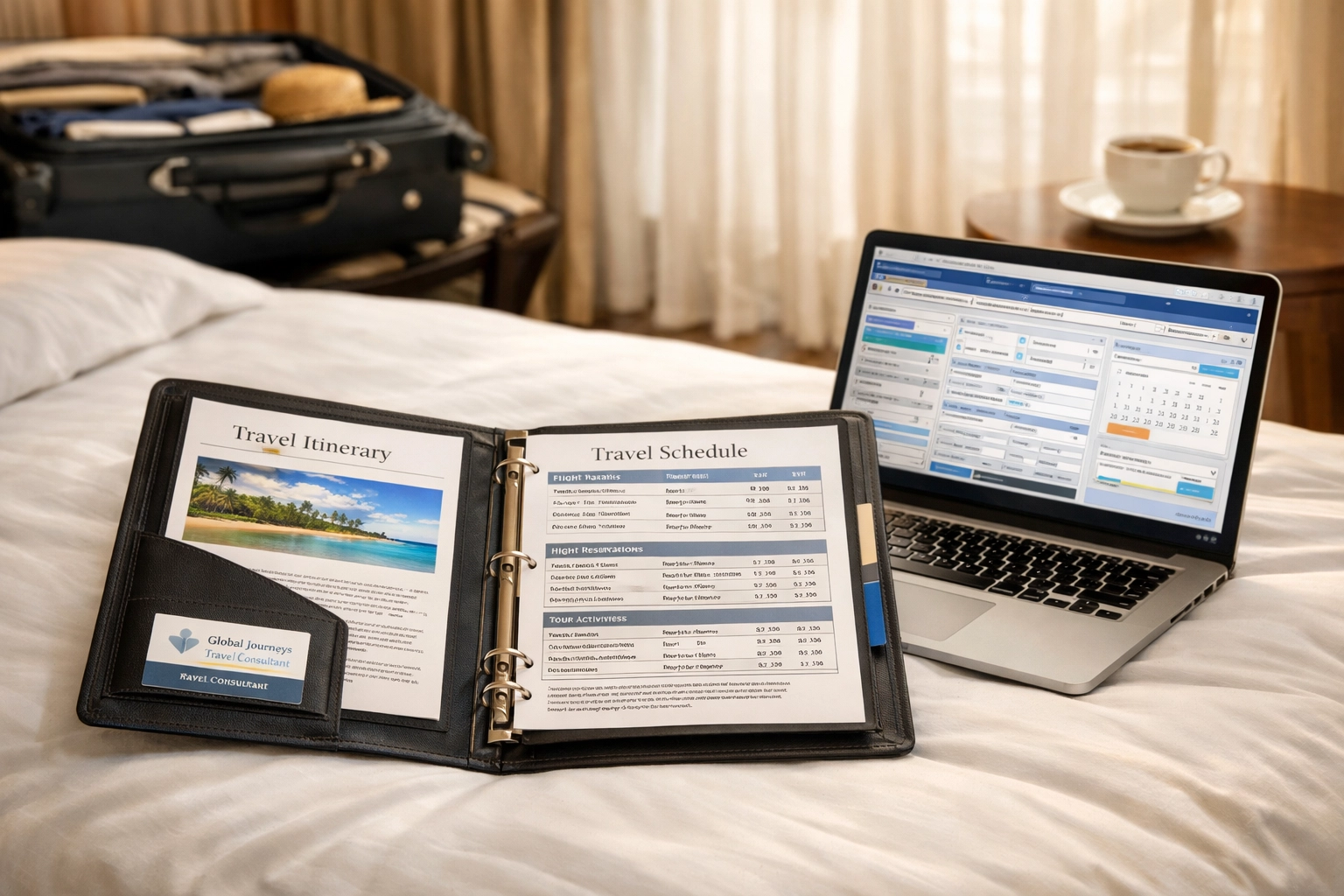
Now imagine this: you spend 20 minutes on the phone describing what you want. A week later, you receive a complete itinerary. Hotels booked. Transfers arranged. Restaurants reserved. Activities scheduled. Contingency plans in place. All you have to do is show up.
Time is money. If you make $50,000 a year, your time is worth roughly $25 an hour. If you spent 30 hours planning your vacation, you just “spent” $750 of your time. What did you save by booking it yourself? Maybe $200 in fees?
You lost money. And you lost time you could’ve spent doing literally anything else.
But let’s set aside the math. Let’s talk about what you don’t know.
You don’t know that the hotel you booked just renovated half its rooms and if you don’t specifically request the new wing, you’re getting the old, sad version. You don’t know that the “ocean view” room is technically accurate but requires you to crane your neck at a 45-degree angle to see a sliver of water. You don’t know that Restaurant X is impossible to book online but a travel professional can get you a table. You don’t know that Tour Company Y has a terrible safety record that wouldn’t show up in your Google search.
You don’t know what you don’t know.
And when something goes wrong, because something always goes wrong, you’re on hold with customer service, navigating automated phone trees, begging for a supervisor. Meanwhile, travelers who worked with professionals have someone advocating for them, fixing problems, handling the stress while they actually enjoy their vacation.
What to do instead: Recognize that expertise has value. Stop treating travel planning like a fun hobby when it’s actually a specialized skill set. Your vacation is too important, too expensive, and too rare to leave to amateur hour. Work with professionals who do this for a living. The peace of mind alone is worth it.
“Pack for Every Possible Scenario” (Or: How to Ruin Your Trip Before You Leave)
Let me paint a picture.
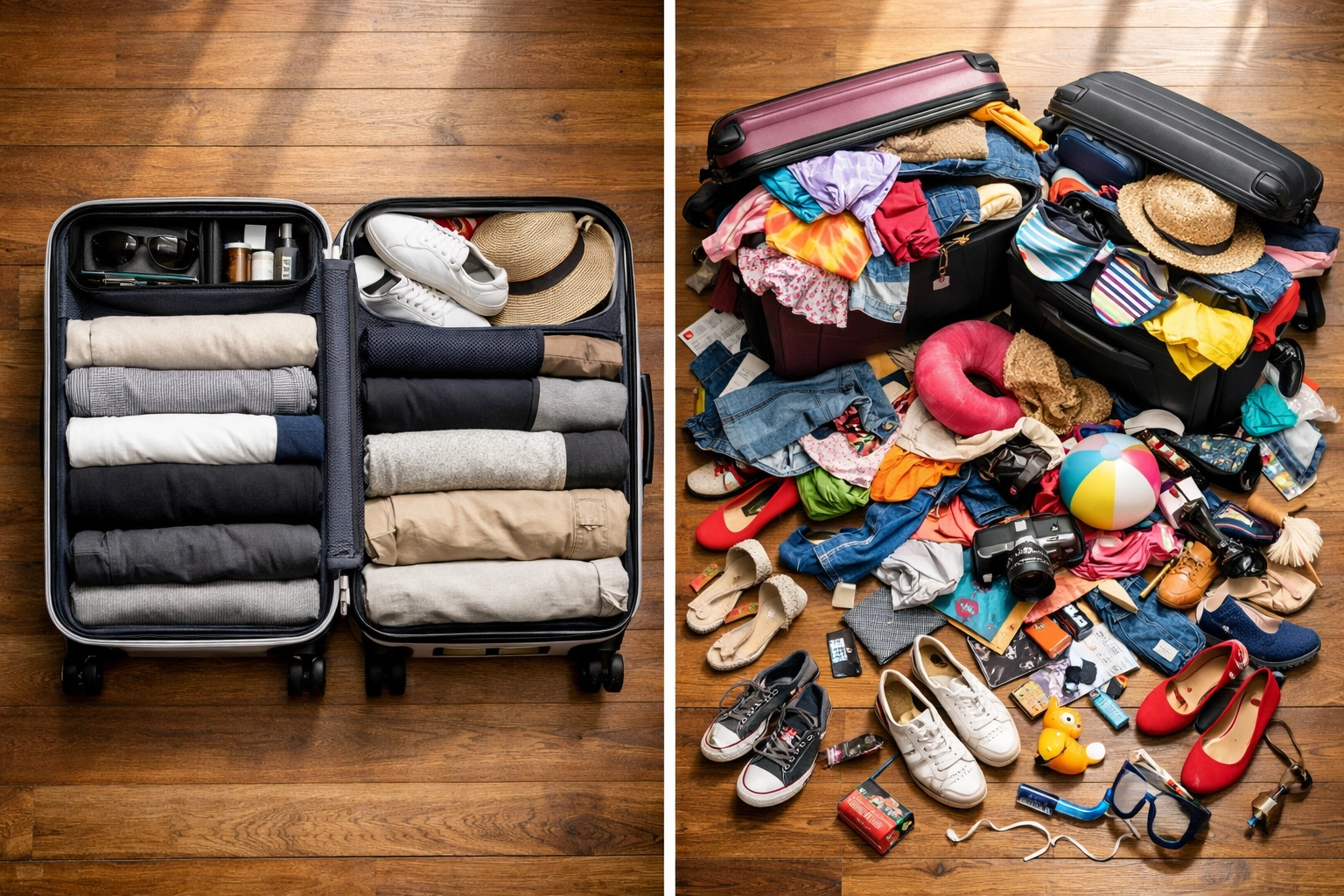
You’re packing for your luxury beach vacation. You’re bringing your swimsuit, obviously. But what if it gets cool in the evening? Better bring a sweater. What if you want to go to a nice dinner? Better pack dress shoes. What if there’s a hiking opportunity? Better throw in athletic shoes. What if, what if, what if.
Before you know it, you’ve got two checked bags, a carry-on, and a personal item. You’re paying baggage fees. You’re lugging weight through airports. You’re waiting at carousel after carousel hoping your bag made the connection. You’re spending the first hour of your vacation unpacking an entire wardrobe into hotel drawers.
All for items you’ll never use.
Here’s the thing about luxury travel: it’s about freedom, not luggage.
The carry-on-only philosophy isn’t about deprivation. It’s about mobility. It’s about walking off the plane and straight to your hotel. It’s about not caring if your flight gets changed because you’ve got everything you need right there with you.
“But what if I need something?” you ask.
Then you buy it. You’re on vacation. In a place with stores. You’ll survive.
And honestly? You probably won’t need it. That “just in case” dress you packed for a fancy dinner you might go to? You won’t go. That second pair of hiking boots because what if the first ones don’t work out? They’ll work out fine. That fourth swimsuit? Girl. No.
What to do instead: Pack what you will use, not what you might use. Build a capsule wardrobe that mixes and matches. Choose versatile pieces. And for the love of vacation happiness, embrace the carry-on life. Your back, your sanity, and your travel experience will thank you.
“Save Money by Staying Further Away” (The False Economy of Cheap Locations)
Oh, this one sounds so logical.
“Hotel A is $300 a night downtown. Hotel B is $150 a night, and it’s only 15 minutes away! Look at all the money you’re saving!”
Except you’re not saving money. You’re relocating your spending from accommodation to transportation and frustration.
Let’s do the math. That $150-per-night hotel that’s “only 15 minutes away”? First, it’s never actually 15 minutes. It’s 15 minutes in ideal traffic that you will never experience. In reality, it’s 25-40 minutes depending on time of day, accidents, construction, and acts of God.
Now you’re taking taxis. Or Ubers. Or dealing with public transportation. Each trip is costing you $20-40. You do that twice a day, once to get to the fun part of town, once to get back, and you’re spending $40-80 daily on transportation.
Over a 5-day trip, that’s $200-400. Congratulations, you’ve now spent the same amount as Hotel A. Except you’ve also spent hours of your vacation in transit.
Let me give you a real example. Cozumel. You book a hotel far from the cruise port to save money. Now you need a taxi to Paradise Beach. The taxi driver wants $18 cash. You don’t have cash. Suddenly it’s $40 with a credit card. That’s not a taxi fare, that’s a hostage situation with wheels.
And it’s not just the money. It’s the mental load. It’s the stress of timing your return. It’s the exhaustion of schlepping back and forth. It’s missing that spontaneous evening stroll because you’re 20 minutes from anywhere worth strolling.
Location matters. In travel, proximity is luxury.
What to do instead: Budget appropriately for location. Consider the total cost, not just the nightly rate. Factor in transportation expenses, time costs, and convenience. Often, spending more on the right location saves you money overall and dramatically improves your vacation quality. Sometimes paying $300 to be where you want to be beats paying $150 to be where you don’t.
“Street Food is Always Dangerous” vs. “Always Eat Like a Local” (Finding the Middle Ground)
These two pieces of advice are natural enemies, locked in eternal combat in the comments section of every travel blog.
Camp A: “Never eat street food! You’ll get sick! Stick to hotel restaurants!”
Camp B: “You MUST eat street food! It’s the soul of a destination! Hotel restaurants are for cowards!”
Both camps are wrong. And both camps are a little bit right.
Here’s the reality: street food around the world is often spectacular. It’s fresh, it’s authentic, it’s delicious, and yes, it’s safe, when you use common sense.
But “always” and “never” are terrible travel advisors.
Should you avoid all street food because you’re afraid? No. You’ll miss some of the best meals of your life. Should you eat at every questionable cart because you want to prove how adventurous you are? Also no. Food poisoning is not a personality trait.
The key is observation. Look for vendors with high turnover, that means fresh ingredients. Watch how they handle food. Check if locals are eating there. Use your instincts. If something looks or smells off, walk away.
On the flip side, don’t let travel snobbery convince you that eating at your resort is somehow cheating at vacation. Sometimes the hotel restaurant is fantastic. Sometimes you’re tired and want a familiar meal. Sometimes you just want a cheeseburger, and that’s okay. You’re not going to lose your traveler credentials.
What to do instead: Be adventurous but not reckless. Try street food when it looks good and clean. Eat at local restaurants that have crowds and good reviews. Also eat at your hotel if you want to. Balance exploration with wisdom. And maybe pack some Pepto, just in case. You’re on vacation, do what makes you happy, not what makes strangers on the internet respect you.
“You Can Sleep When You Get Home” (The Toxic Hustle of Vacation Planning)
This advice usually shows up in the form of motivational travel quotes.
“Adventure awaits! Sleep when you’re dead! The world is calling!”
Listen, I’m all for adventure. But lack of sleep doesn’t make travel more meaningful. It makes travel miserable.
Here’s what actually happens when you don’t sleep on vacation: everything becomes harder. Small inconveniences feel like catastrophes. You’re irritable with your travel companions. You can’t enjoy the museum because you’re fighting to keep your eyes open. You snap at the waiter. You make poor decisions about activities and spending. You miss the sunset because you crashed at 6 PM.
You’re not experiencing more by sleeping less. You’re experiencing less because you’re too exhausted to actually be present.
Jet lag is real. Travel fatigue is real. Your body needs rest, especially when you’re in unfamiliar environments, walking more than usual, and navigating new situations.
Some of the best moments of travel happen when you’re well-rested and alert. You notice details. You have energy for spontaneity. You can actually appreciate that incredible view instead of staring at it through a fog of exhaustion.
What to do instead: Build rest into your itinerary. Don’t pack every minute of every day. Allow for downtime. Take a nap if you need one. Sleep in if you want to. You’re on vacation: the goal is to return home refreshed, not requiring a second vacation to recover from your vacation.
“Skip Travel Insurance: It’s a Waste of Money” (Until It Isn’t)
This is the one nobody wants to think about. Travel insurance feels like jinxing yourself. “I’m not going to need it,” you think. “Nothing bad is going to happen.”
And then it does.
Flights get canceled. Bags go missing. Someone gets sick. Weather disrupts your plans. The hotel you booked goes out of business. You break your ankle snorkeling. Your wallet gets stolen. Your phone falls in the ocean.
When something goes wrong far from home, the financial, emotional, and logistical costs are substantial.
Travel insurance isn’t for the 99% of trips where nothing goes wrong. It’s for the 1% where everything does. And that 1% can cost you thousands of dollars, hundreds of hours of stress, and memories of the worst vacation of your life.
I’ve seen it happen. The family whose connecting flight was canceled with no available alternatives for three days. The couple whose luggage disappeared, along with all their medications. The traveler who needed emergency medical care in a country where their health insurance didn’t work.
The ones with travel insurance? Annoyed but protected. The ones without? Financially devastated.
What to do instead: Buy travel insurance. Read the policy. Understand what’s covered. It’s not sexy. It’s not exciting. It’s not going to make you look adventurous on Instagram. But it’s one of the smartest investments you can make in your travel.
“Take Advice from Anyone Who Has an Opinion” (When Everyone’s an Expert)
Here’s the final: and perhaps most important: piece of bad advice:
Taking advice from anyone who has an opinion.
The internet democratized travel information, which is mostly good. But it also means every person with a blog, social media account, or strong feeling thinks they’re a travel expert.
Someone who has never traveled with kids might have strong opinions about family travel. Someone who’s never planned a multi-city itinerary might insist you should wing it. Someone who’s never been to your destination might tell you it’s dangerous. Someone who had one bad experience might tell you to avoid an entire country.
Not all advice is equal. Not all experience translates to expertise.
The person telling you to “just show up” at popular attractions has probably never stood in a five-hour line. The person insisting you pack in a carry-on might be 5’2″ and traveling solo: not 6’4″ traveling with a spouse and two kids. The person saying you don’t need a travel agent might have unlimited time to spend on research and no problem sitting on hold with airlines for hours.
What works for them might not work for you.
What to do instead: Seek advice from people who have been where you want to go: physically or figuratively. Listen to professionals who plan travel for people with similar needs as yours. Consider the source. Ask yourself: does this person actually know what they’re talking about, or are they just confident?
Trust expertise. Trust experience. Trust people who have made mistakes and learned from them. Don’t trust someone just because they speak loudly or type in all caps.
The Real Travel Hack Nobody Talks About
Here’s the actual secret to great travel: work with professionals who do this for a living.
It’s not sexy. It’s not a “hack.” It’s not going to trend on TikTok. But it works.
The worst travel advice usually comes from people trying to save money in the wrong places, over-planning in some areas while under-planning in others, and treating travel like a competition instead of an experience.
The best travel experiences come from having a foundation of smart planning, professional guidance, and enough flexibility to embrace spontaneity when it happens naturally.
Stop following travel “hacks” that waste your time, money, and peace of mind. Stop taking advice from people who’ve never done what you’re trying to do. Stop treating vacation planning like a solo mission when professionals exist specifically to make your life easier.
Your vacation is too valuable for amateur hour.
Plan the framework. Get expert help. Then actually enjoy yourself. That’s the real travel advice worth following.
Dave Galvan, author of this amazing tome, is a travel author, luxury travel concierge, travel blogger, travel vlogger, travel tour guide, travel podcaster and traveler. When he’s not debunking terrible travel advice, he’s helping people plan incredible vacations that actually live up to the hype.
Ready to stop following bad advice and start planning a trip that actually works? Visit www.TimeForYourVacation.com, check out www.DaveTheTourGuide.com, or explore more travel wisdom at www.TimeForYourVacation.blog.
You can also tune into the podcast at https://www.podomatic.com/podcasts/contact24682 for more travel real talk and insider tips that actually matter.
Because the best travel hack is working with someone who knows what they’re doing. And that’s not advice; that’s just common sense.
 Time For Your Vacation
Leave a comment